How do you start a podcast for your business?
Listen to the episodeStart with the job the show should do for your business, not a microphone: settle the listener, the angle and the hours, then judge it on that job.


Chapter 1 of 3Should You Start
Topics join your trail as you reach them.
Definitions appear here as you reach them.
About four in ten podcasts launched in the first half of 2026 had stopped publishing by the end of June, by one podcast-data company's count . Lasting is the hard part. So how to start a podcast for your business begins with the job the show should do for the business, not with a microphone. Before recording, settle three things: who it is for, what only you can make and how many hours it takes. Launch to people who already know you. Then give it a fixed run, and judge it on the job you gave it.
Narrated by a synthetic version of Lam Hoang's own voice.
Summary
- A business show needs a job outside itself: slow trust with the right people, not next quarter's sales.
- Before recording, settle one listener, an angle only your business has and a format your calendar can carry.
- The real cost is hours. Gear and hosting can start free, with three checks on a free host: the cap, the ads and the exit.
- Launch in Apple's order, trailer and pitch first, then ask ten people one by one to follow and rate.
- After six months of steady episodes, judge it on its job, not its downloads.
Should you start?
Only if the show has a job outside itself: something should happen for the business because the show exists. Jay Acunzo, who has made more than a dozen shows , asks companies one question more than any other. In a Q&A for Managing Editor he gives it as "Why do you have a podcast?" If the honest answer is that someone wanted one, "you have to be OK not getting any results." The same interview says podcasts are "better suited for depth and resonance, not reach and net new audience." Acunzo sells a show-premise workshop, a course and advisory work.
Why the job matters. Inside Radio's report on Podchaser's Class of 2026 counted 153,767 new podcasts worldwide that released a first episode between January 1 and June 30, 2026. Of those, 64,100 (41.7%) had stopped publishing by the end of June. Three limits sit beside that number. It is one data company's count, read through a trade report because Podchaser's own was not reachable. It does not define stopped. And the newest shows were days old when counted.
Be realistic about the job. Pacific Content, a studio that makes shows for companies, says it in Dan Misener's account of how it develops new podcasts : "if your goal is to drive short-term sales for next quarter, an original series might not be the best fit." That is a seller of branded shows steering buyers away from its own product.
The return has no independent measure. On October 10, 2026, the research for this episode searched for one: what a business podcast returns in leads, pipeline, sales or brand lift. It found only sellers' figures, none with a published method. A paywalled study could exist; free search did not surface one. So when someone promises leads, treat that as the seller's claim. To me, a business show is a slow way to earn trust with the right people. Cliff Ravenscraft, who coaches podcasters, describes the same path in his episode on shows that generate clients : "A podcast can help people discover and trust you."
Two checks from NPR. NPR Training's checklist for starting a podcast , by its audio storytelling specialist Alison MacAdam, asks "Is a podcast the best format for this? Why?" and "Do we have the people, time and resources to make this?" NPR sells no podcast services. If either answer is no, that is the answer for now. Start as a guest on other shows instead, or by writing.
The free test. Answer three questions, one sentence each:
- Who is the show for?
- What should they do or believe after listening?
- Why does that help your business?
No answers yet means no recording yet. The test is this show's synthesis of the teachers here, not any one teacher's words, and nobody has tested whether shows with a stated goal last longer.
Who is it for?
One listener, and the problem the show solves for them. Eric Nuzum was once NPR's vice president of programming and wrote Make Noise, a book on making podcasts. In an interview with Lauren Passell for Podcast Marketing Magic he says: "Successful podcasts solve problems for listeners." Nuzum co-founded Magnificent Noise, a podcast production and consulting company.
The ten-word test. Nuzum's test for a show idea, as Dave Jackson's guide to starting a podcast quotes it from Make Noise: "Describe your idea in no more than ten words, and do so in a way that describes nothing else in the world." The book itself was not read for this episode. If ten words cannot set your show apart, you have a topic, not a show yet. That conclusion is mine, and it matches Acunzo's line: "WHAT you explore is not a premise."
An angle only you have. The angle is what makes the show this business's and nobody else's. Dan Misener, then director of audience development at Pacific Content, told UserTesting's Insights Unlocked what makes a show one "only we" can make: "Sometimes it's access to unique guests, proprietary research, or a niche perspective." He adds a warning: "If you only make a show about what a brand wants to say, you're rapidly approaching infomercial territory." The studio's development page is blunter: "A show for 'everybody' is a show for nobody." In practice the angle is often research, data or expertise the business has never had time to share. A made-up example:
- The business: a small accounting firm.
- The listener: an owner who dreads tax season.
- The angle: the mistakes the firm fixes each spring.
- The job: more owners call before they file. If they do, the show is working.
Format follows the angle and the calendar. The format is the shape every episode repeats: solo, co-hosted or interview. Lower Street, a branded-podcast agency, writes in its content strategy guide : "don't start with the guest. Start with the topic." The Podcast Host's step-by-step guide lists "Grow your network" among an interview show's pros, and among its costs "Booking logistics, and scheduling interviews" and "Builds less loyalty since it's a new person every week." The Podcast Host is the education brand of Alitu, which sells podcast editing, recording and hosting software. Jackson's guide puts the trade in two lines: "A solo show grows your influence. An interview show grows your network." No study compares formats for a business show, and sellers sit on both sides. Pick the one your calendar can carry. A podcast is a series: whatever one episode takes, every episode takes.
What will it cost?
Mostly hours, not money. Dave Jackson has taught podcasting since 2005, by his own account, and sells a membership, courses and coaching. His guide sets the test: "Before you pick your schedule, measure your production time." Then: "If it takes seven hours to produce one episode, ask yourself honestly: do you have seven hours a week?" Time one episode, start to finish. Then pick a schedule those hours can carry.
Pace. The guides disagree, and none has data. The Podcast Host's guide says "The best schedule is normally the most frequent one that you can stick to, on a regular basis," and "You'll have a bigger impact if you put out one excellent episode a month instead of a very average episode every week." Buzzsprout, a hosting company, recommends weekly : "We recommend publishing once a week to develop a connection with listeners and create the habit of producing consistent content." Nobody has tested which pace grows a show. I'd pick the pace you can hold.
Gear. Spotify for Creators' beginner guide , from February 2026, says a smartphone or computer "already has a built-in microphone and camera for getting started," and "While not perfect, they're sufficient for your first episodes while you learn the basics." Spotify runs a free podcast host with built-in recording tools, so advice to start with what you have suits its business. The same guide says the room "can make or break your episode": look for "somewhere quiet with minimal echo." A camera can wait. If you sell expertise or services, you can start without filming. Video gets its own episode.
Hosting. A podcast host stores the episodes and serves the feed the listening apps read. On October 9 and 10, 2026, the research for this episode read thirteen hosts' own pricing, help and terms pages. Seven have a free plan. Eleven of the twelve with a paid plan start at $12 to $20 a month (median $16, our arithmetic). But free means different things. Check three things before episode one: the cap, the ads and the exit. The exit is a 301 redirect, a setting on the old host that sends the apps and your listeners to the new feed.
| Host | Free plan or trial | Cheapest paid plan, as printed | Free-plan limits and ads | Leaving |
|---|---|---|---|---|
| Spotify for Creators | Free, unlimited | No paid hosting plan | Ad revenue share on shows that opt to monetize | 301 redirect; how long it stays is not stated |
| Buzzsprout | Free | $15 a month, billed annually | 2 upload hours a month; episodes leave the feed after 90 days | 301 redirect; keep the account three weeks; canceling deletes content at once |
| Podbean | Free | $17 a month | 5 hours of lifetime storage, a 20-episode feed; terms allow ads, with no revenue to you | 301 redirect |
| RSS.com | Free | $15 a month, billed annually | No caps, one show; no ads of its own | Redirect, but not on free trial accounts or after you cancel |
| Acast | Free for five episodes | $14.99 a month | Ads after five episodes, revenue shared | Redirect in settings; no duty to keep content after canceling |
| RedCircle | Free | $19.99 a month | Unlimited, one show; ads are opt-in | 301 redirect, kept while the show is not deleted |
| Spreaker | Free | $20 a month | One show, six months of statistics | A redirect field |
| Captivate | 30-day trial | $19 a month, $17 paid yearly | No free plan | Redirect when moving; content deleted within 30 days |
| Transistor | 14-day trial | $19 a month | No free plan | 301 redirect that stays in place after you cancel |
| Libsyn | 30 days free | $12 a month | No free plan | 301 redirect, kept after closing (archived 2022 page) |
| Castos | 14-day trial | $19 a month | No free plan | Redirect; four weeks advised |
| Simplecast | 14-day trial | $15 a month | No free plan | 301 redirect, kept after closing (archived 2024 article) |
| Blubrry | A "start for free" label, unexplained | $7 a month for 1.5 hours of new content | Not stated | Canceling stops the feed; old feed addresses may return "410 Gone" |
Sources: each host's own pages. Spotify for Creators' hosting switch guide and redirect guide ; Buzzsprout's pricing , free plan , transfer guide and terms of service ; Podbean's free plan limits , pricing , move guide and podcaster terms ; RSS.com's free plan , pricing and redirect guide ; Acast's pricing , Starter plan , redirect guide and creator terms ; RedCircle's plans , redirect guide and ad insertion page ; Spreaker's plans and feed settings ; Captivate's pricing , cancellation guide and terms ; Transistor's pricing and redirect guide ; Libsyn's plans and archived redirect guide ; Castos' pricing and redirect guide ; Simplecast's pricing and archived redirect article ; Blubrry's hosting page , cancellation page and terms .
Three of the seven free plans cap or expire what you publish, and two tie the plan to ads. Twelve hosts describe a redirect; four promise it survives canceling. On Blubrry, Buzzsprout's redirect guide and Podbean's redirect guide say its support sets the redirect. Nothing was tested, and prices move. Choosing a host gets its own episode.
The bigger cost stays the hours. A business without them can buy them: our breakdown of what podcast production services include splits the work into stages, and WorkHacker's content production service makes shows like this one.
How do you launch?
Don't wait until it feels perfect. Pat Flynn, podcasting since 2010, writes in his step-by-step tutorial : "If you wait until you feel good about your show before you hit publish on episode one, I guarantee you will never have a podcast." It took him a year and a half to publish his first episode. Flynn sells a course and earns from tools his guide recommends, among them Fusebox "as both your podcast host and podcast player of choice." But don't publish unheard either. Jackson's guide : "Don't publish the first thing you record," and "Get honest feedback before you go public." Play it to one honest listener first. Fix what they point at.
Apple's order. As of October 2026, Apple's feed requirements ask for "At least one episode" and artwork before a show can be submitted, and every show passes technical validations and a review before it appears. Apple's editors also pick new shows to feature by hand. A trailer is a short episode that introduces the show before the full ones, and Apple's editorial curation page makes it the entry ticket: "In order to submit a pitch for a new show, you will need at least a trailer live in the new show's feed." It asks for the pitch "at least two weeks in advance of when you plan on releasing your first full episodes," with your launch plan, featuring art and "advance audio of full episodes." Not every show is featured. One limit: Apple's content guidelines say "Don't provide incomplete content, including sample or trailer episodes for podcasts which are not or will not be shortly available in Apple Podcasts." So the trailer goes up when the full episodes are close. These pages print no date and change. Reread them on your publishing day.
So that's my order: trailer and pitch first, full episodes two weeks later.
How many episodes. Apple requires one. Teachers split between one, three and up to five, with no data either way. Jackson: "Launch with 3-5 episodes so new listeners have something to binge." Daniel J. Lewis, in an episode on launching with several : "One episode is all that's required to get your podcast in nearly all apps and directories." I'd launch with as many as you can finish without delaying.
Tell people yourself, one at a time. The Podcast Host's guide says "Make a shortlist of 10 people to personally tell" and "Personal messages get far better results than broadcast posts." That is the company's experience, not a measurement. Ask each person to follow the show, and to rate it once they have listened. The reason is Apple's charts page : the charts use a mix of listening, follows and completion rate. Ratings, reviews and shares "are not factored into the algorithm," but they "influence whether people will listen or follow, and those factors influence the charts." Apple adds: "Automatic downloads are not factored into rankings, and rankings cannot be purchased or sold."
A launch-day push, or a soft open. Some teachers also make launch day one push to everyone you know. Flynn: "Launch like it's an event." Buzzsprout's guide calls that the grand opening, "the approach used by most podcasters with an existing following," against a soft open, where you "publish episodes as if people are listening, but wait to promote your episodes." No test compares them.
Launch day is the start, not the plan. Sounds Profitable's Podcast Discovery Playbook 2026 describes "why discovery is a 12-month system, not a 12-week push." It was made with JAR Podcast Solutions, which sells growth services, and only its report page was read. JAR's Roger Nairn, on Buzzsprout's Top 100 Podcast show : "Treat your discoverability as a 12-month discipline." Finding listeners gets its own episode.
How do you judge it?
Expect small numbers, and decide in advance what counts. Buzzsprout publishes its own platform statistics . For September 2026, they show how many downloads a new episode gets in its first seven days.
| Rank among Buzzsprout podcasts | First-week downloads per episode |
|---|---|
| Median (top 50%) | 27 |
| Top 25% | 96 |
| Top 10% | 412 |
| Top 5% | 1,007 |
| Top 1% | 4,586 |
Source: Buzzsprout's platform stats , September 2026, all genres.
That covers 111,813 active podcasts, counted to the IAB's measurement guidelines. It is one host's own customers, every kind of show, with no cut for business shows, and the page changes monthly.
A business does not need a crowd. Ravenscraft, in the same episode on clients : "Depending on your business model, you may only need twenty, thirty, or fifty clients each year," and "With a genuinely high-value offer, you may only need five or ten." He has made more than fifty shows, by his own account , and sells a course, a mastermind and coaching. Nobody has measured how many clients a business show brings, so treat it as an argument to test.
Judge the job, not the downloads. A. Lee Judge, writing for the Content Marketing Institute : "Listenership isn't your goal - business is." Judge founded Content Monsta, a podcast and video production company, so this too comes from a seller. Dan Misener, now a co-founder of the analytics company Bumper, told HubSpot's Marketing Against the Grain that "Downloads are a byproduct of some kinds of podcast consumption," and to read each app's own listener data: "Audiences vote with their play buttons." The judgment comes down to two things: whether the right people heard it, and whether anything happened outside the show. Sweet Fish Media, a B2B podcast agency, suggests one way to find out in its content strategy guide : "Implement 'How did you hear about us?' forms during the sales process to gauge podcast effectiveness in the funnel."
Give it six months. I'd run six months of steady episodes before judging it. The rule comes from Pat Flynn, in an episode on what to know before starting : "So six months minimum." It is one teacher's rule of thumb, not a measured payback time, and the quote is from an auto-generated transcript. Of his own show, he says it was "over a year later," in its fifties and sixties of episodes, that he started to realize "how powerful the platform was." No study gives a payback time for a business show. So at six months, judge the job, not the payback.
Slow down or stop on purpose. Buzzsprout's page on podfade , its name for shows that quietly stop: "Most listeners will understand if you take a break, as long as you keep them informed about why you won't be releasing new episodes for a while." Ravenscraft did exactly that in August 2026. After 32 weeks of two weekly shows, he wrote in Podcast Answer Man 509 that weekly publishing "is no longer the minimum effective dose for what these shows are designed to accomplish in my business," and cut both to at least one episode a month: "My podcasts still deserve my time. They just do not deserve as much of it as I have been giving them." One case. It is a decision, not a fade.
What to do this week
- Write one sentence each: who the show is for, what they should do or believe after listening, and why that helps the business. A blank means not yet.
- Describe the show in ten words that describe nothing else.
- Record and edit one practice episode on the phone or computer you have, timed start to finish. Pick the schedule those hours carry.
- If a free host tempts you, read its plan, terms and redirect page for the cap, the ads and the exit.
- List ten people who would find the show useful, to message one by one at launch.
- Write down what the job looks like when it works, and book the six-month review now.
FAQ
How many episodes should a new business podcast launch with?
Apple requires one episode and artwork to submit a show, and wants an editorial pitch, with a trailer live, two weeks before the first full episodes. Teachers split between one, three and five episodes, with no data. Launch with as many as you can finish without delay.
Can a business start a podcast for free?
The gear and the hosting can start free. A phone or computer is enough for the first episodes, and seven of thirteen hosts checked in October 2026 have a free plan. Check each free plan's cap, ads and exit first. The real cost is hours, so time one episode before choosing a schedule.
How long does a business podcast take to work?
No study gives a payback time for a business show. Pat Flynn's rule of thumb is six months minimum, and his own show was over a year old before he saw what it could do. Judge it at six months on the job you gave it, not on downloads.
Yours to use.
Start with the prompt. Keep the guide alongside it.
Start here
Free prompt: set up an AI podcast project for your business
Supply your details, or answer a short interview, to get instructions to paste, populated starter files and a workflow for one supervised pilot, or a next decision if you are not ready.
- Copy the prompt into Claude, ChatGPT or Gemini. Choose to start a project, improve your existing setup or decide whether a podcast is worth doing. Use the AI you already have; the prompt asks for no paid tool or purchase.
- Paste rough notes or sanitized material about your business, listener, pilot question and sources, format, voice, approving role, tools and review capacity. Separate editorial review time from final listening time. Details supplied up front lead straight to the prepared package with gaps marked. Otherwise, answer only the missing questions. Skip private client information and never paste passwords.
- Review the package's assumptions and proposed choices, then save the instructions and files using your chosen route or the chat fallback. Use its fresh-chat check and pilot starter; resolve pending decisions before production. Without browsing, use pasted sources and keep unchecked claims visible. Review sources and script, save agreed correction rules, and listen to the final audio before approving publication. Setup, audio and publishing remain manual.
Alongside it
 Open full-size preview
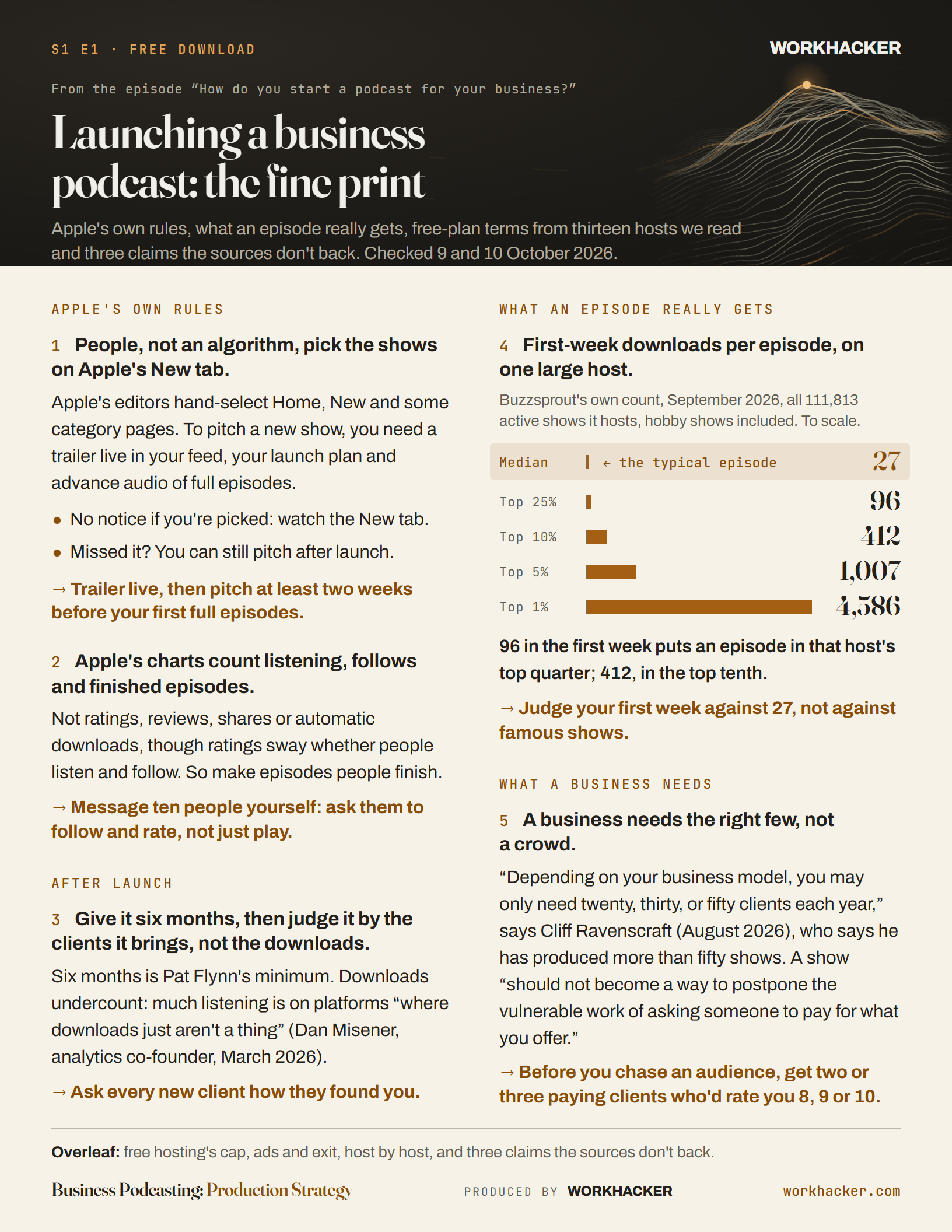
Launching a business podcast: the fine print
Apple's launch rules, what an episode really gets, free-plan fine print from thirteen hosts and three claims the sources don't back. Free, two pages, every fact dated.
Download PDFRead along with the episode
Should You Start
This is Business Podcasting: Production Strategy, produced by WorkHacker. I'm your host, Lam Hoang, co-founder of WorkHacker. You're hearing a synthetic version of my voice. Each episode I take one question about making a podcast for your business, tell you what I would do and how solid the evidence is. Today's question: how do you start a podcast for your business?
About four in ten new podcasts from the first half of 2026 had stopped publishing by July. That's one podcast-data company's count, and it doesn't define stopped. So hold the number loosely. What does a start that lasts look like for a business? Here's where I land. Start with the job the show should do for your business.
Not with a microphone. Before you record, settle three things. Who it's for, what only you can make and how many hours it takes. Launch it to people who already know you. Then give it a fixed run, and judge it on the job you gave it. Making it perform for your business? That's what this series is for. Here's what you'll leave with.
A test for whether you're ready, and what to settle before recording. Then the price in hours, a launch plan and how to judge it. First: are you ready to start at all? Jay Acunzo has made more than a dozen shows. He asks companies one question more than any other. Why do you have a podcast? If the show exists because someone wanted one, he says you have to be okay with getting no results.
So the show needs a job outside itself. Something should happen for the business because the show exists. But be realistic about what that something is. One studio that makes shows for companies puts it this way. If your goal is next quarter's sales, an original series might not be the best fit. And nobody has published an independent measure of what a business show returns.
So when someone promises you leads, treat that as the seller's claim. To me, a business show is a slow way to earn trust with the right people. Then run two checks from NPR's training team. Is a podcast the best format for this idea? Do you have the people and the time to make it? And the resources? If either answer is no, that's an answer.
You might start as a guest on other shows instead, or by writing. Here's a test that costs nothing. Who is the show for? What should they do or believe after listening? And why does that help your business? If you can't answer them yet, you're not ready to record.
Listener, Angle and Hours
Second, what do you settle before you record? Settle the listener first. Pick one, and the problem the show solves for them. Eric Nuzum was once NPR's vice president of programming. In his words, "successful podcasts solve problems for listeners." He has a test for a show idea. Describe your show in ten words or fewer, in a way that describes nothing else in the world.
Can't do it? Then you have a topic, not a show yet. What gets you past that test is an angle that's yours. Dan Misener ran audience development at a branded-podcast studio, and he asks what show only your company could make. His answer is sometimes access to unique guests, proprietary research or a niche perspective.
He also has a warning. A show only about what the brand wants to say is heading for infomercial territory. So build on what your business knows, and aim it at the listener's problem. A lot of times it's research, data or expertise you've never had time to share. Say you run a small accounting firm. Your listener is an owner who dreads tax season.
Your angle is the mistakes you fix each spring. If more owners call you before they file, the show is doing its job. Your format should follow from that, not from a guest list. A podcast agency puts it simply: start with the topic, not the guest. Interviews can grow your network. But a podcast-software company's guide says they take booking and scheduling.
It adds that they build less loyalty, because the guest changes every week. No study compares formats for a business show. So pick the one your calendar can carry. Why the calendar? A podcast is a series. Third, what will it really cost you? Mostly hours. Not money. Dave Jackson has taught podcasting since 2005, and his test is simple.
Time one episode, start to finish. If it takes seven hours, ask yourself honestly whether you have seven hours a week. Then pick a schedule those hours can carry. With agents doing most of the production, the cost moves to review. It takes more of your time at first and less as the show proves itself. One guide says the best schedule is usually the most frequent one you can stick to.
It also says one excellent episode a month beats a very average one every week. A hosting company's guide recommends weekly instead. Nobody has tested which pace grows a show. I'd pick the pace you can hold. What about gear? A major listening app's beginner guide from February 2026 says your phone or computer will do.
It calls them not perfect but sufficient for your first episodes. The same app runs a free podcast host, so it's not a neutral party. And a camera? If you sell expertise or services, you can start without filming. Video has its own episode. Hosting can be free at the start, too. About half the hosts checked for this episode have a free plan.
Paid plans mostly start at twelve to twenty dollars a month. But free means different things. So check three things before episode one: the cap, the ads and the exit. Some free plans cap or expire what you publish. Some are paid for with ads in your show. And leaving takes a redirect that sends your listeners to the new host.
Not every host keeps it running after you cancel. Gear and choosing a host get their own episodes later.
Launch, Then Judge
Fourth, how do you get the first episodes out? Don't wait until it feels perfect. Pat Flynn has podcasted since 2010, and he took a year and a half to publish his first episode. His warning is blunt. Wait until you feel good about the show, and you'll never have one. But don't publish the first thing you record unheard, either. Play it to one honest listener first.
Fix what they point at. Then launch the way Apple describes it. As of October 2026, Apple requires at least one episode and cover art before you can submit a show. Its editors also hand-pick new shows to feature, though not every show gets picked. To pitch yours, you need at least a trailer live in your feed. Apple asks for the pitch at least two weeks before your first full episodes, with advance audio of them.
So that's my order: trailer and pitch first, full episodes two weeks later. Teachers split between one, three and up to five with no data either way. I'd launch with as many as you can finish without delaying. Then tell people yourself, one at a time. Make a list of ten people who'd really find the show useful, and message each one.
Ask them to follow it. And to rate it once they've listened. Why? Apple's charts count listening and follows. Ratings and reviews aren't counted directly, but Apple says they sway whether people listen and follow. Some teachers also make launch day one big push to everyone you know. But launch day is the start, not the plan.
Finding listeners gets an episode of its own. Last, how will you know it's working? Expect small numbers. And decide in advance what counts. One large podcast host publishes its own figures. In September 2026, the typical show's new episode got twenty-seven downloads in its first week. That's every kind of show on that host, not just business shows.
It can sound tiny. But a business doesn't need a crowd. Cliff Ravenscraft coaches podcasters, and he puts numbers on it. Depending on your model you may need only twenty to fifty clients a year, he says. So judge the show on its job, not its downloads. Did the right people hear it? Did anything happen outside the show?
One simple way to find out is to ask new clients how they found you. And give it time. I'd run it for six months of steady episodes before judging it. That's one teacher's rule of thumb, not a measured payback time. He calls it a minimum. His own show was over a year old before he saw what it could do. So at six months, judge the job.
Not the payback. If you slow down or stop, do it on purpose and say so. The coach behind those client numbers did just that in August 2026. He cut two weekly shows to at least monthly, and told his listeners why. That's a decision, not a fade. So here's the rule. Start with the job the show should do for your business.
Know who it's for and what it costs in hours, then tell the people who know you first. And judge it on its job after six months. The first step costs nothing. Before you buy a thing, write down who the show is for. Then what they should do after listening. And why that helps your business. A free prompt for your own AI to set up your podcast project, plus the launch fine print, comes with the written version.
And that's it for today's question. Know someone with the same question? Send them this episode. Thanks for listening. The written version is on workhacker.com, with every source. And if you want a podcast like this for your business, WorkHacker makes them. See you next time.
Sources you can check.
Every reference, with the publication and checked dates we recorded.
- Podcasts creators focus on quality over quantity (reporting Podchaser, Podcasting's Class of 2026)Inside Radio
Published: Checked:
- How to make a podcast people loveJay Acunzo
Published: Checked:
- Read This Before You Start a Branded PodcastManaging Editor
Published: Checked:
- How we develop new podcasts at Pacific ContentPacific Content
Published: Checked:
- Podcast Answer Man 508: Five Questions Every Podcaster Must Answer Before Expecting Their Show to Generate ClientsCliff Ravenscraft
Published: Checked:
- Want to start a podcast? Read this firstNPR Training
Published: Checked:
- Eric Nuzum advises podcast startupsIdeastream Public Media
Published: Checked:
- "Marketing is not a real thing in podcasting." A conversation with Eric NuzumPodcast Marketing Magic
Published: Checked:
- How to Start a Podcast in 2026: The Complete GuideSchool of Podcasting
Published: 2026Checked:
- Branded podcast advice from Bumper's Dan Misener (Insights Unlocked, episode 39)UserTesting
Published: Checked:
- How to Create a Podcast Content StrategyLower Street
Published: Checked:
- How to Start a Podcast: Complete Step-by-Step Guide (2026)The Podcast Host
Published: Checked:
- How to Start a Podcast: Complete Step-by-Step Guide [2026]Buzzsprout
Published: Checked:
- How to start a podcast: The creator's step-by-step guideSpotify for Creators
Published: Checked:
- Switching your show's hosting to Spotify for CreatorsSpotify for Creators
Published: undatedChecked:
- Switching away from Spotify for Creators with a 301 redirectSpotify for Creators
Published: undatedChecked:
- Buzzsprout PricingBuzzsprout
Published: undatedChecked:
- Buzzsprout Free PlanBuzzsprout
Published: undatedChecked:
- Transferring podcast from BuzzsproutBuzzsprout
Published: undatedChecked:
- Buzzsprout Terms of ServiceBuzzsprout
Published: undatedChecked:
- Podbean Basic Free Plan: Features & LimitsPodbean
Published: Checked:
- Podbean PricingPodbean
Published: undatedChecked:
- Moving to a New Host?Podbean
Published: Checked:
- Podbean Podcaster Agreement Master TermsPodbean
Published: Checked:
- The Free planRSS.com
Published: Checked:
- Podcast Hosting PricingRSS.com
Published: undatedChecked:
- How do I Redirect My Podcast Feed to a Different Hosting Provider?RSS.com
Published: Checked:
- Plans and PricingAcast
Published: undatedChecked:
- Acast's free Starter planAcast
Published: undatedChecked:
- How to redirect your podcast, cancel your subscription or delete your accountAcast
Published: Checked:
- Terms and conditions for creators (standard)Acast
Published: Checked:
- RedCircle Account PlansRedCircle
Published: undatedChecked:
- Redirecting Your Podcast Away From RedCircleRedCircle
Published: undatedChecked:
- Dynamic Insertion for the RedCircle Ad Platform (RAP)RedCircle
Published: undatedChecked:
- Find the perfect plan to suit your podcasting needsSpreaker
Published: undatedChecked:
- Podcast settings on your Spreaker RSS feedSpreaker
Published: Checked:
- Pricing PlansCaptivate
Published: undatedChecked:
- How do I cancel a podcast?Captivate
Published: Checked:
- Terms & ConditionsCaptivate
Published: Checked:
- Podcast hosting pricing: how much does it cost?Transistor
Published: undatedChecked:
- How to forward your Transistor podcast feed - 301 Redirect | Transistor HelpTransistor
Published: Checked:
- Podcast Hosting Costs by PlanLibsyn
Published: undatedChecked:
- Configuring 301 Redirects & New Feed URL Tags on Your Libsyn Show (archived)Libsyn (Internet Archive copy)
Published: Checked:
- Flexible & Transparent PricingCastos
Published: undatedChecked:
- Redirect your podcast's RSS feedCastos
Published: Checked:
- Plans & PricingSimplecast
Published: undatedChecked:
- Can I move my RSS feed away from Simplecast? (archived)Simplecast (Internet Archive copy)
Published: Checked:
- Blubrry Podcast HostingBlubrry
Published: undatedChecked:
- What Happens If You Cancel Your Blubrry Hosting?Blubrry
Published: undatedChecked:
- Terms of ServiceBlubrry
Published: Checked:
- Redirect Podcast RSS FeedBuzzsprout
Published: undatedChecked:
- Redirect Podcast Feed With a 301 RedirectPodbean
Published: Checked:
- How to Start a Podcast STEP-BY-STEP: 2026 Complete TutorialSmart Passive Income
Published: 2026Checked:
- Podcast RSS feed requirementsApple Podcasts for Creators
Published: undatedChecked:
- Submit a new showApple Podcasts for Creators
Published: undatedChecked:
- Editorial curation on Apple PodcastsApple Podcasts for Creators
Published: undatedChecked:
- Content guidelinesApple Podcasts for Creators
Published: undatedChecked:
- Should You Launch a Podcast with Multiple Episodes? (TAP329)The Audacity to Podcast
Published: Checked:
- Apple Podcasts ChartsApple Podcasts for Creators
Published: undatedChecked:
- The Podcast Discovery Playbook 2026 (report page)Sounds Profitable
Published: Checked:
- The New Rules for Growing a Podcast in 2026 (Roger Nairn)Top 100 Podcast (Buzzsprout)
Published: Checked:
- Buzzsprout Platform StatsBuzzsprout
Published: 2026-09Checked:
- Podcast Answer Man (show page)Cliff Ravenscraft
Published: undatedChecked:
- How To Achieve Business Podcasting Success (and Pitfalls To Avoid)Content Marketing Institute
Published: Checked:
- Downloads are a lie: how to focus on the podcast metrics that actually matterMarketing Against the Grain (HubSpot)
Published: Checked:
- How To Build a B2B Podcast Content StrategySweet Fish Media
Published: Checked:
- SPI 859: Listen to This Before Starting a Podcast (5 Things They Don't Tell You)Smart Passive Income
Published: Checked:
- What is Podfade?Buzzsprout
Published: Checked:
- Podcast Answer Man 509Cliff Ravenscraft
Published: Checked:
What did you think of this episode?
A question, a useful takeaway, or something we could do better. We'd like to hear it.
Your note goes to the WorkHacker team. It won't appear publicly.
How do you start a podcast for your business?
Notes on search, AI and automation.
Practical notes from WorkHacker, delivered by email when we have something useful to share.