Step 1
Start with the questions people ask.
A search-led show begins with demand, not a list of topics. We measure what your buyers search for, group the phrases that share an audience, and choose the question that opens the show. The biggest number is not always the right audience.
Browse podcast ideas for your industry
On Business Podcasting
The first episode answers an owner's first decision.
- how to start a podcast18,100Start with the owner's first decision, before equipment or formats.
- how long should a podcast be210A smaller question still matters before production. Give length its own useful answer.
- podcast names4,400Naming is a specific decision. Answer it separately rather than crowding the opening episode.
- ai voice33,100The research flags this phrase as generic. Its volume is not demand for making a business podcast.
DataForSEO Labs, US / English, 8 October 2026. Search estimates, not listeners. Related phrases share overlapping demand; we do not add the estimates together. Download the dated search excerpt
Step 2
Name the listener and the promise.
Who is listening, where, and what do they leave with? The answer becomes one sentence the show keeps in every episode.
On Business Podcasting
Each episode I take one question about making a podcast, tell you what I would do and how solid the evidence is.
Lam Hoang, from the show plan
Our listener is deciding how to make a show for their business. They listen in the car, on a walk or between meetings, and each episode answers a decision they will face.
Step 3
Choose a title people can find.
The title names the audience and the work, in words people search for. Episode titles are questions, so each episode can be found on its own.
On Business Podcasting
'Business podcasting', 'podcast for business' and 'business podcast' share about 3,600 estimated US searches a month. We do not add those estimates together. The description, 'How to start a podcast for your business', narrows the broader 'how to start a podcast' to the owner we want to help.
DataForSEO Labs, US / English, 8 October 2026. Search estimates, not listeners or visits.
Want a second look at your own show idea?
Start with an auditStep 4
Pick the format and the voice.
The format follows what the listener needs: an explanation, a conversation or a how-to. The voice can be AI narrated in the host's consented voice, the host's own recording or interviews. The material sets the length, not a target. Three ways to voice a show
On Business Podcasting
Chosen for this show
A point of view, supported by research.
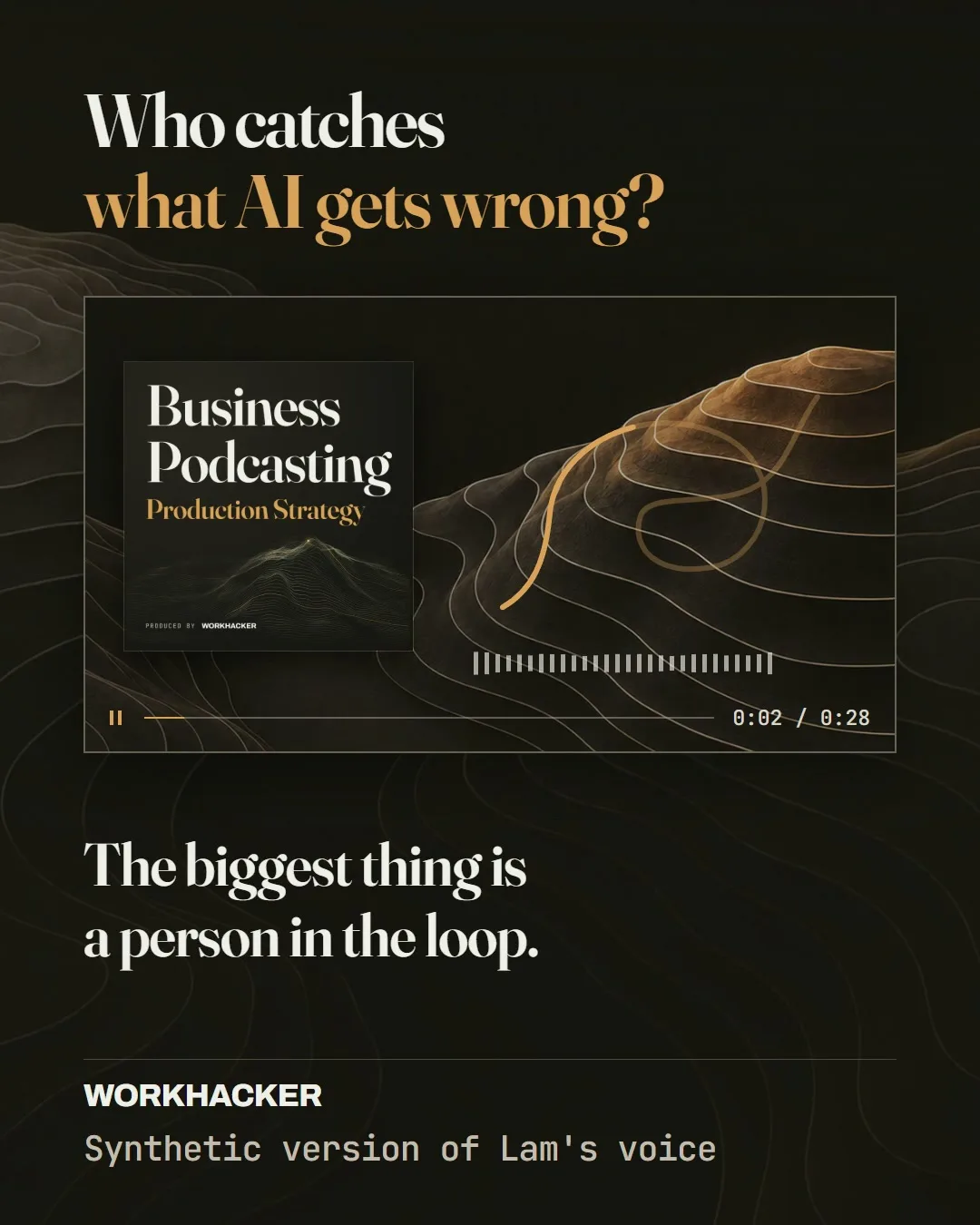
Lam-hosted episodes: Narrated by a synthetic version of Lam Hoang's own voice. Rob-hosted episodes: Narrated by a synthetic version of Rob Garner's own voice. Research and scripts pass human review before production. Every episode includes an on-air production-method disclosure. Lam listens to every episode before it goes out.
Our first prototype episode asked how long an episode should be. Its 13:57 broke into five parts.
- 1Is shorter really safer?
2:51
- 2The evidence base
2:21
- 3Format decides length
2:17
- 4Where listeners leave
3:32
- 5Why it comes last
2:56
The decision: let the material choose the length. Hear the formats in our show
Step 5
Order the first season.
A season follows the decisions your listener faces, in the order they face them. Each question earns its place with a real decision, evidence to answer it and a reason to come next.
On Business Podcasting
Our first six questions
- 01
How do you start a podcast for your business?
Begin with the decision to make a show.
- 02
Should your podcast use an AI voice?
Explain the voice a listener will hear.
- 03
How long should a podcast episode be?
Let the material determine the length.
- 04
Do you need video for your podcast now?
Decide whether the answer needs pictures.
- 05
Podcast names: how do you choose one people can find?
Give a specific naming decision its own answer.
- 06
How do you get a new podcast found?
Prepare the routes through which people can find it.
Two threads run through the season: strategy sessions on positioning, format and topics, and AI in production, from research to review. Hear the show
Step 6
Decide how every claim is checked.
The plan settles who checks what before anything is published. Sources are saved on the day they are read, every claim is graded, and your expert approves what only they can vouch for.
On Business Podcasting
- A
Primary or peer-reviewed
A disclosed research method, or a platform's own rule read at source.
- B
Industry evidence
A survey or platform dataset with a stated method. Name its sponsor.
- C
A published claim
Vendor figures or company statements without a shown method.
- D
Judgment or experience
Opinion, a single case or our own inference, identified as such.
Planning frameworks: Acunzo on premise; Procida on learning needs; Minto on structure; MacAdam on listening; Tufte on evidence. These are teaching approaches, not performance results.