How do you make a podcast with AI?
Listen to the episodeYou direct the AI and own what it makes. How one show splits the work, what stays yours, and how much to review as the models change.
Yours to useWhat the frontier labs advise for working with AI agents

Chapter 1 of 3Who Does What
Topics join your trail as you reach them.
Definitions appear here as you reach them.
You make a podcast with AI by directing it and owning what it makes. As of fall 2026, a model can do most of the work of making a show. It needs three things from you: written guidelines, a vision and oversight. So you set the direction. You review the work, heavily at first, and turn your notes into checks so the review gets lighter. And you answer for what goes out, legally too. This show, Business Podcasting, is made that way, with the help of AI.
Narrated by a synthetic version of Lam Hoang's own voice.
One podcast search engine, Listen Notes, counts new podcasts by month in its podcast stats tables . For September 2026 it lists 8,848 human-created podcasts and 3,040 "AI-generated fake podcasts removed": 11,888 in all, so about one in four. The label is Listen Notes' own. Its method page says automated scripts and human moderators keep "AI-generated junk" out of its index, and it publishes no accuracy figure. Listen Notes sells podcast data, and the count covers its own index: feeds worldwide, in every language, not listening. The table is live; these figures were read on 12 October 2026. Using a model is not the problem. Putting in less work because you used one is. That is what people call AI slop. The way to avoid it is to direct the AI and own what it makes.
Summary
- You direct and you own the result. As of fall 2026, a model can do most of the work of a show, given guidelines, a vision and oversight.
- This show splits it like this: I set the direction, models research, draft and check, and I listen to every episode and go through every source before it publishes.
- The decision, the taste and your context stay yours. Without your direction, a model falls back on its default.
- Review heavily at first. Each note becomes a rule, and a check where a script can test it, so the review gets lighter.
- Each new model is the cue to test one step of your workflow again.
Who does what, you or the AI?
For this show, I set the direction. That means who the show is for and the questions it takes on. It also means the format of each episode, what the show stands for and the rules every episode follows. Those rules live in two documents: a written format and a rulebook built from my notes.
The rest of the work splits like this.
| Step | Who does it | What keeps it honest |
|---|---|---|
| Direction | Me: the audience, the questions, the format and the rules | A written format and a rulebook built from my notes |
| Research | A model, which stores a copy of every page it cites | Every quoted line is checked against that stored copy |
| Script | A model, writing to the format and the rules | The rulebook, plus scripted checks on every round |
| Claim check | A separate model | It rates every claim against its source, from faithful to unsupported |
| Listen | Me, start to finish, with the script beside me | I approve the episode or send it back with notes |
| Source pass | Me, before the episode publishes | I go through every one of its sources myself |
The stored copies matter more than they look. Pages change and links break. With a copy of each page kept on the day it was read, any claim can be checked later against the exact words it came from.
Check the citations while the script is drafted, not only at the end, so a weak source is caught before the script is finished. On this show a separate model checks every claim against its source before I hear the episode, and my own pass through the sources comes before it publishes.
And the voice really is mine. I just don't record the episodes. I'm not a professional podcaster; my work is websites, search and automation. Reading on mic every week isn't practical for me, or in my nature.
Some listeners draw their line at the voice. Edison Research's Evolving Ear study, presented in a webinar on 27 January 2026 from 2025 survey data and listener interviews, found listeners open to AI for background tasks: scripting help, brainstorming, editing and transcription. As Radio Ink reported the study , hosting, narration, banter and improvisation "were repeatedly described as the 'human core' of podcasting." Listeners also criticized AI voices for lacking nuance, emotional inflection and spontaneity. These are qualitative responses relayed by trade press, not a measured share of listeners.
I agree with them. That's why we spend a lot of time making sure the voice sounds right: every episode is voiced and I review it by listening, and a pronunciation list is applied to every word the voice says. But hosting is also choosing what gets said. I still do that. For me, it's this voice or no show. Whether your show should use a synthetic voice is episode two, "Should your podcast use an AI voice?"
Why lean into AI at all?
This part is my view, not a finding. There's more worth doing in the world than people with the time to do it. So the question is what we could do with more intelligence on hand. Having a tutor on call and a PhD to collaborate with should make our work better, not sloppier.
Machines should help with machine tasks, like editing photos. In this show, three of them run by machine:
- The sound. Code measures the master's loudness and peaks and evens them out.
- The chapters. They are timed from the word timestamps of the finished audio.
- The title cards. The titled cover this show shares on social media is drawn by code from a template.
Those tasks are different from the human part of the work: the judgment, the taste and the choices.
These tools will also let far more people make things. Look at websites. When my family got a computer back around 2000, people were building their own sites for fun: custom pages first, then Xanga and MySpace. A lot of that enthusiasm faded as most of us came to build inside other people's platforms, with only so much control. Now people are designing their own sites again and building their own tools. It feels like the early web again: a small renaissance in website design. Websites are just one example of what is happening across many fields.
The upheaval is real, though. So are the worries about who owns these tools and whether they widen gaps in power and income. Those are worries about control, not about the tasks a machine does. Still, I see a future where this technology helps.
What do you keep for yourself?
The decision, the taste and knowing your context. It's not that a model can't help you think about what's best for your business. It just doesn't care enough to. So you have to tell it what you need. Put generic in and you'll get generic out.
Without your direction, the model falls back on a default. Jill Walker Rettberg of the University of Bergen uploaded different kinds of text to one AI podcast tool, NotebookLM's Audio Overviews, and analysed what it made. Her 2026 study of AI-generated podcasts , in Media, Culture and Society, reports: "I show how the podcasts' structure is built around a fixed template." She also found the tool turned other languages and cultures into a standard American default. It is one researcher's qualitative analysis of one tool, read here from the abstract, and it describes that tool as of 2026, not every model. The point holds as a test: hand a model your material without your direction, and check whether what comes back is yours or its default.
The creative work stays with you, and so does the responsibility.
Your thinking also sets the bar. A show has to be worth hearing for people in your category, beyond the buyers you care about. Every episode should teach those listeners something, or entertain them. A model can draft toward that bar. Deciding where the bar sits is your job.
How much do you review when the tools keep changing?
A lot at first. Review heavily while you iterate, until the episodes follow your vision and your guidelines. As your formats settle, you can review less.
Notes turned into automatic checks make the review lighter. Here is how one note became a check on this show:
- The note. An early script said "my take" too often. Much of the show is what the evidence says, not my opinion.
- The rule. The note went into the rulebook the scripts are written to.
- The check. A script now counts first-person phrases like that one in every draft and flags them.
- The result. The same note doesn't reach me twice.
Agents and extra steps, such as a second model hunting for mistakes, can raise accuracy before the work reaches you. But someone always approves every episode, and the review stays your job.
The models keep moving. As of fall 2026, new ones arrive about monthly. In February I wrote, in What Building Looks Like in 2026 , that "What was a limitation yesterday is a capability today." One example was computer use. At the start of 2025, agents couldn't use a computer well. By the time I wrote that post, about a year later, it was routine. So what's published about the models' limits wears out fast, and this workflow could change tomorrow too. The only way to know what the latest models can do is to test them yourself.
A new model is your cue to test again. Check whether it can take on more of the work, and whether your steps should change. That's the moment to improve your workflow.
Keeping up can wear you out, though. My approach, from the same post, is to watch closely but build deliberately. Take what matters for your problems, and let the rest go.
We're always experimenting at WorkHacker, and I think everyone should be experimenting with these tools, on a podcast and in everyday work. It doesn't have to be a major part of your work. You don't have to voice your show with a synthetic voice. Use a model to correct a line, or for a short voice-over. Not trying these tools is, in my view, a mistake. They're what comes next, and they let us fix things and get more done.
I'm not saying everyone should make a podcast. It's a lot of work, and a lot of thinking. The people best at it have done it for a while, or really love it. If you don't love it now, AI won't make you love it. It might just make it sloppy. So have people who love the work handle your podcast production for you. Whether and how to start a podcast for your business is the next episode, "How do you start a podcast for your business?"
What the frontier labs advise
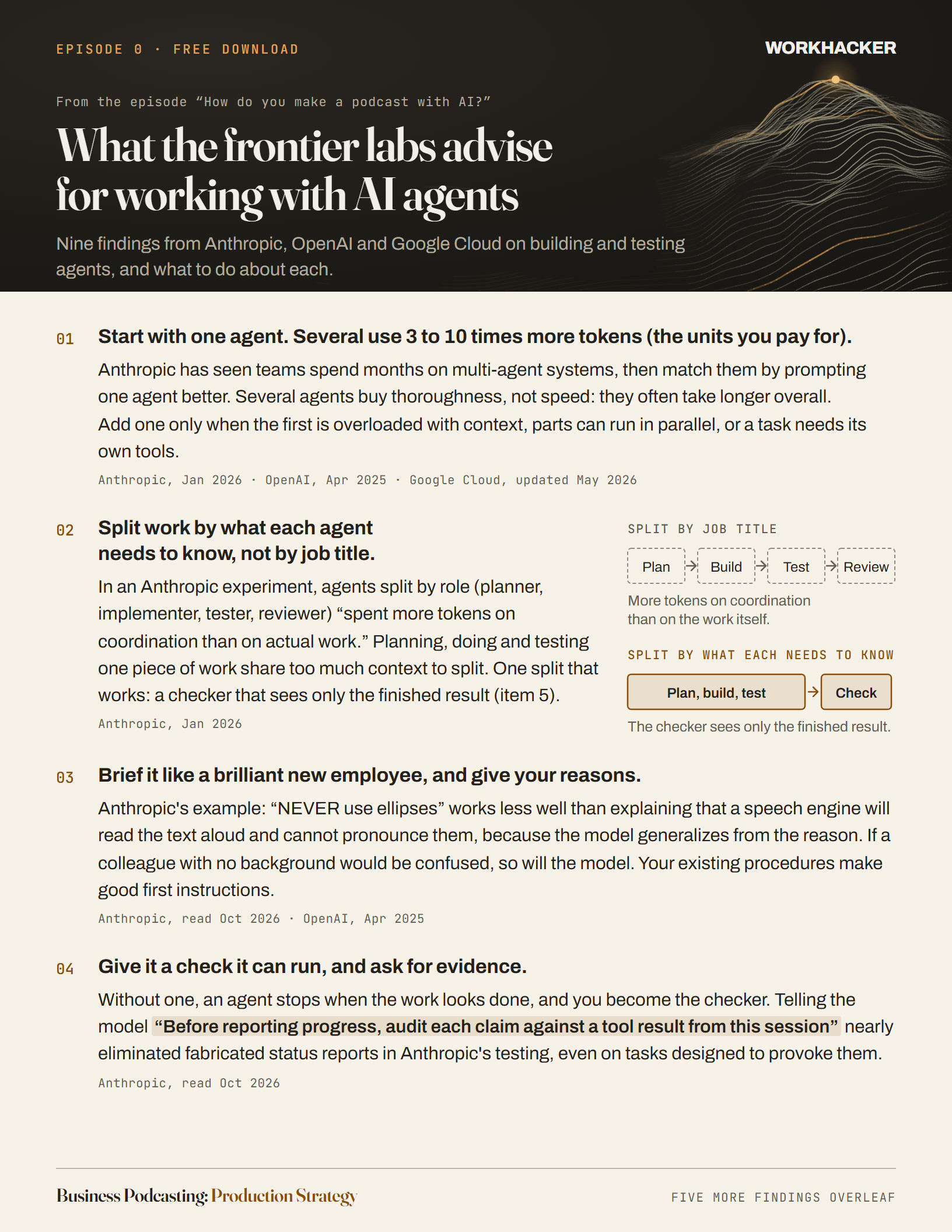
This show's workflow is modeled on what the frontier labs publish about working with AI agents. Their advice is general, not our recipe. Nine practices, each from the labs' own pages:
- Start simple. Anthropic's guide to building effective agents separates fixed workflows from agents and advises the simplest setup that works. OpenAI's practical guide to building agents recommends "to maximize a single agent's capabilities first."
- Write the job down. OpenAI's Codex best practices break a request into its goal, its context, its constraints and what "done" means. Anthropic, in how it built its multi-agent research system , found that "Without detailed task descriptions, agents duplicate work, leave gaps".
- Give the reason behind each rule. Anthropic's prompting best practices advise clear, direct rules with the reason given, and dialling back aggressive wording. Its best practices for coding agents add: "If you emphasize many lines, none of them stands out."
- Ask for a plan before a hard task. OpenAI's Codex guide says to have the agent plan first when a task is complex, ambiguous or hard to describe, and Anthropic's coding-agent guide works the same way.
- Leave notes for the next session. Anthropic's harnesses for long-running agents have the agent "write summaries of its progress in a progress file", and its guide to context engineering keeps structured notes outside the model's working memory.
- Have a separate agent review the work. Anthropic's harness design for long-running development notes that agents asked to judge their own work tend to praise it, so it uses a separate evaluator. Google Cloud's guide to agentic design patterns describes the same review-and-critique pattern.
- Give it a check it can run. OpenAI's Codex guide asks for tests and checks before accepting work, and a written rule when the agent makes the same mistake twice. Anthropic's guide to evals for agents builds them from "20-50 simple tasks drawn from real failures".
- Keep a person at the checkpoints. Google Cloud recommends a human in the loop for "human oversight, subjective judgment, or final approval for critical actions." OpenAI's guide says high-stakes actions "should trigger human oversight until confidence in the agent's reliability grows."
- Re-test when a new model arrives. Anthropic's harness design post says "every component in a harness encodes an assumption about what the model can't do", and its post on scaling managed agents adds: "Harnesses encode assumptions that go stale as models improve."
The free guide below goes further: nine findings from the labs, with their numbers, on one sheet, front and back.
What to do this week
- Write your direction on one page: who the show is for, the questions it takes on, the format of each episode and the rules every episode follows.
- Pick one step you still do yourself, and test the newest model on it this week. Hand the model your guidelines, then review what comes back as a draft.
- Keep a copy of every page your research cites, saved the day you read it, so any claim can be checked against its page later.
- Turn each note you give twice into a written rule, and into a check wherever a script can test it.
- Before anything publishes, listen to the whole episode with the script beside you, and go through its sources yourself.
FAQ
Can AI make a podcast on its own?
As of fall 2026, a model can do most of the work of making a show, but only with guidelines, a vision and oversight from a person. Without that direction it falls back on a default: a 2026 study by Jill Walker Rettberg found one AI podcast tool built its shows on the same fixed template. A person still sets the direction, reviews every episode and owns what goes out.
How much should you review an AI-assisted podcast?
Heavily at first, until the episodes follow your vision and your guidelines. As the format settles, you can review less, because each repeated note becomes a rule and, where possible, an automatic check. Someone still approves every episode before it publishes.
What stays with a person when you make a podcast with AI?
The decision, the taste and knowledge of your business's context. A model can help you think, but it does not care what is best for your business, so you have to tell it. On this show, the person also listens to every episode in full and goes through every source before it publishes.
Yours to use.
Start with the guide. The prompt is available alongside it.
Start here
 Open full-size preview
What the frontier labs advise for working with AI agents
Nine findings from Anthropic, OpenAI and Google Cloud on working with AI agents, with their numbers and what to do about each. Free, one sheet, front and back.
Download PDFAlongside it
Free prompt: set up an AI podcast project for your business
Supply your details, or answer a short interview, to get instructions to paste, populated starter files and a workflow for one supervised pilot, or a next decision if you are not ready.
- Copy the prompt into Claude, ChatGPT or Gemini. Choose to start a project, improve your existing setup or decide whether a podcast is worth doing. Use the AI you already have; the prompt asks for no paid tool or purchase.
- Paste rough notes or sanitized material about your business, listener, pilot question and sources, format, voice, approving role, tools and review capacity. Separate editorial review time from final listening time. Details supplied up front lead straight to the prepared package with gaps marked. Otherwise, answer only the missing questions. Skip private client information and never paste passwords.
- Review the package's assumptions and proposed choices, then save the instructions and files using your chosen route or the chat fallback. Use its fresh-chat check and pilot starter; resolve pending decisions before production. Without browsing, use pasted sources and keep unchecked claims visible. Review sources and script, save agreed correction rules, and listen to the final audio before approving publication. Setup, audio and publishing remain manual.
Read along with the episode
Who Does What
This is Business Podcasting: Production Strategy, produced by WorkHacker. I'm your host, Lam Hoang, co-founder of WorkHacker. You're hearing a synthetic version of my voice. Each episode I take one question about making a podcast for your business, tell you what I would do and how solid the evidence is. Today's question: how do you make a podcast with AI?
By one tally's own judgment, about one in four new podcasts in September 2026 were AI-made fakes. But using AI isn't the problem. Putting in less work because you used it is. That's what people call AI slop. The way to avoid it: you direct the AI, and you own what it makes.
As of this fall, it can do most of the work of making a show. It needs three things from you to get there: guidelines, a vision and oversight. So you set the direction. You review the work, heavily at first. And you answer for what goes out, legally too. That's how this show is made, with the help of AI. Here's what you'll leave with.
How this show splits the work, and why it leans in. Then what to keep for yourself, and how much to review as the models change. First: who does what, you or the AI? For this show, I set the direction. That means who the show is for and the questions we take on. It also means the format of each episode, what the show stands for and the rules every episode follows.
AI gathers the research. It keeps a copy of every page it cites. So any claim can be checked against its page. Then a model drafts the script to my direction. A separate model checks every claim in the script against the page it came from. Then I listen to every episode from start to finish, with the script beside me. I approve each one or send it back with notes.
Each note becomes a rule for later episodes. And before an episode publishes I also go through every one of its sources myself.
Why Lean Into AI
And the voice really is mine. I just don't record the episodes. I'm not a professional podcaster. My work is websites, search and automation. Reading on mic every week isn't practical for me, or in my nature. Some listeners draw their line at the voice. In Edison Research's Evolving Ear study from 2025 data, listeners called hosting and narration the human core of podcasting.
I agree. That's why we spend a lot of time making sure the voice sounds right. But hosting is also choosing what gets said. I still do that. For me, it's this voice or no show. Whether your show should use a synthetic voice is episode two. Second: why lean into AI at all? The way I see it, there's more worth doing in the world than people with the time to do it.
So what could we do with more intelligence on hand? Having a tutor on call and a PhD to collaborate with should make our work better, not sloppier. Machines should help with machine tasks, like editing photos. The same goes for evening out an episode's sound and timing its chapters. Or making the title cards a show shares on social media.
Those tasks are different from the human part of the work: the judgment, the taste and the choices. AI will let far more people make things. Look at websites. When my family got a computer back around 2000, people were building their own sites for fun. First custom pages, then Xanga and MySpace. Since then, a lot of that enthusiasm has faded.
Most of us now build inside other people's platforms, with only so much control. But people are designing their own sites again and building their own tools. It feels like the early web again: a small renaissance in website design. And websites are just one example of what we see across many fields. The upheaval is real, though. So are the worries about who owns these tools and whether they widen gaps in power and income.
Those are worries about control, not about the tasks a machine does. Still, I see a future where this technology helps. Third: what do you keep for yourself? The decision, the taste and knowing your context. It's not that AI can't help you think about what's best for your business. It just doesn't care enough to.
So you have to tell it what you need. Put generic in and you'll get generic out. Without your direction, the model falls back on a default. A 2026 study gave one AI podcast tool different kinds of documents. The tool built the shows on the same fixed template. The creative work stays with you, and so does the responsibility.
Your thinking also sets the bar. A show has to be worth hearing for people in your category, beyond the buyers you care about. Every episode should teach those listeners something, or entertain them. That thinking is the work I do for people.
Reviewing as Models Change
Last: how much do you review, when the tools keep changing? A lot at first. Review heavily while you iterate, until the episodes follow your vision and your guidelines. As your formats settle, you can review less. Notes turned into automatic checks make the review lighter. One early note: the scripts said "my take" too often.
Now a check catches that, so the same note doesn't reach me twice. Agents and extra steps such as a second model hunting for mistakes can raise accuracy before the work reaches you. But someone always approves every episode. And the review stays your job. And the models keep moving. This fall, new ones arrive about monthly.
In February, I wrote that what was a limitation yesterday is a capability today. One example I gave was computer use. At the start of 2025, agents couldn't use a computer well. About a year later, that was routine. So what's published about the models' limits wears out fast, and this workflow could change tomorrow too.
The only way to know what the latest models can do is to test them yourself. A new model is your cue to test again. Can it take on more of the work? Should your steps change? That's the moment to improve your workflow. We're always experimenting at WorkHacker. Keeping up can wear you out, though. My approach is to watch closely but build deliberately.
Take what matters for your problems, and let the rest go. Still, we should all be experimenting with AI. That goes for a podcast and for everyday work. It doesn't have to be a major part of your work. You don't have to voice your show with a synthetic voice. Use it to correct a line, or for a short voice-over. But I believe not trying these tools is a mistake.
They're what comes next. They let us fix things and get more done. So let the machine do as much of the work as it does well. You set the direction, review every episode and own what goes out. Pick one step you still do yourself, and test the newest model on it this week. Hand the model your guidelines. Then review what comes back as a draft.
I'm not saying everyone should make a podcast, though. It's a lot of work. And a lot of thinking. The people best at it have done it for a while, or really love it. If you don't love it now, AI won't make you love it. It might just make it sloppy. So have people who love the work make it for you. Whether and how to start a podcast for your business is the next episode.
Whoever makes yours, this series looks at how to make a podcast that performs for your business. We take questions like these. Who actually listens? Which format fits? How do you get found? And should you use an AI voice? The show is about podcasting for business. It's also about what work looks like now that AI does more of it.
And where work goes from here. Our workflow is modeled on what the frontier labs advise for working with AI agents. Their advice is on one sheet, free to download with the written version. Thanks for starting with us. Know someone thinking about a podcast for their business? Send them this episode. The written version is on workhacker.com, with every source.
And if you want a podcast like this for your business, WorkHacker makes them. See you next time.
Sources you can check.
Every reference, with the publication and checked dates we recorded.
- Podcast Stats (raw tables)Listen Notes
Published: Checked:
- Podcast Stats: How many podcasts are there?Listen Notes
Published: undated (live page)Checked:
- Edison's Evolving Ear Finds Limits to AI Acceptance in AudioRadio Ink
Published: Checked:
- AI-generated podcasts: Synthetic Intimacy and Cultural Mistranslation in NotebookLM's Audio OverviewsarXiv (Jill Walker Rettberg, University of Bergen; Media, Culture and Society)
Published: Checked:
- What Building Looks Like in 2026Lam Hoang (dryp.dev)
Published: Checked:
- Building effective agentsAnthropic
Published: Checked:
- A practical guide to building agentsOpenAI
Published: April 2025 (no date printed; the PDF was created 2025-04-07)Checked:
- Choose a design pattern for your agentic AI systemGoogle Cloud
Published: Checked:
- Codex best practicesOpenAI
Published: undatedChecked:
- How we built our multi-agent research systemAnthropic
Published: Checked:
- Prompting best practicesAnthropic
Published: undatedChecked:
- Best practices for Claude CodeAnthropic
Published: undatedChecked:
- Effective harnesses for long-running agentsAnthropic
Published: Checked:
- Effective context engineering for AI agentsAnthropic
Published: Checked:
- Harness design for long-running application developmentAnthropic
Published: Checked:
- Demystifying evals for AI agentsAnthropic
Published: Checked:
- Scaling Managed AgentsAnthropic
Published: Checked:
What did you think of this episode?
A question, a useful takeaway, or something we could do better. We'd like to hear it.
Your note goes to the WorkHacker team. It won't appear publicly.
How do you make a podcast with AI?
Notes on search, AI and automation.
Practical notes from WorkHacker, delivered by email when we have something useful to share.