What podcast ideas work for a business?
Listen to the episodePodcast ideas that work for a business come from your customers' world, not your catalogue: worth hearing without the sale, with enough in them to last.
Yours to useCompany podcasts, decoded

Now listening
Use the progress bar to choose a moment.
Topics join your trail as you reach them.
Definitions appear here as you reach them.
Summary
- Look for the idea in what your customers do and love, more than in what you sell. Ask what your products are for.
- An idea works, in my view, when someone who never buys would still want it, for what it teaches or how it entertains. Entertaining doesn't have to mean funny.
- In Pew Research Center's December 2022 survey, entertainment and learning were each a major reason to listen for more than half of American podcast listeners. Hearing a pitch wasn't among the reasons.
- Pat Flynn's twenty-five episode ideas test whether you can keep a show going, not whether anyone will listen. At one a week, twenty-five is about half a year.
- No study we found ties a kind of show idea to more business. The four shows here are illustrations, not proof.
What podcast ideas work for a business? The ones that come from your customers' world, not your catalogue: the part of your subject they already care about. An idea works when it's worth hearing without the sale, because it teaches or it entertains, and when there's enough in it to last. To find out, sketch twenty-five episodes before you commit, then count how many a person who never buys would still want. That's my position, built from podcasting teachers' advice and checked shows. No study we found ties a kind of idea to more business.
Narrated by a synthetic version of Lam Hoang's own voice.
Where does a good podcast idea come from?
From what your customers do and love, more than from your products. Ask what your products are for. That's where the show is.
Take the outdoor retailer REI. Wild Ideas Worth Living , REI Co-op's interview show, calls itself on Apple "High-impact interviews for those who love adventure and the outdoors." A journalist host talks with explorers, athletes, scientists and entrepreneurs about the wild ideas they made real. Apple lists 437 episodes since 2016, updated weekly.
By our read of the titles, none of its last twenty episodes, from 26 May to 6 October 2026, is about gear. They are adventures and records (rowing from California to Hawaii, the full Iditarod on skis), outdoor advice (healthy feet, pacing an ultramarathon runner) and other outdoor subjects, such as bike commuting and happiness. REI sells the gear. The show is about what you do with it.
Behind the numbers. "Weekly" is the show now, not its whole run. Its public feed, by our count on 11 October 2026, starts on 1 December 2016, runs weekly in 2017 and from 2022, and about every other week from 2019 to 2021. The selling sits in the episode notes: sponsors such as Capital One and the REI Co-op Mastercard, Smartwool and The North Face, and pointers to REI's other shows. We found no listener figure (1,272 Apple ratings is not an audience size) and nothing on what the show does for REI's sales. It shows where an idea can come from, not that the idea pays.
It works the same way if you sell to businesses. The podcast page on Stack Overflow's blog sits under a header listing what the company sells: enterprise knowledge tools, data licensing, and Stack Ads, to "engage developers". The show's description on Apple says it explores "what it means to be a developer and how the art and practice of software engineering is changing our world". Its last twenty episodes, from 14 August to 9 October 2026, came out about twice a week. By our read of their titles, they are about building software and AI agents, with guests from other companies; one covers the company's own developer survey. So the show is mostly about developers' work, not the products it sells.
Behind the numbers. Apple lists 991 episodes from 2019, though the show's own description says "well over a decade", so we give no start year. With 64 Apple ratings, we make no claim about its audience.
Both shows still fit the business that makes them. They just aren't about the catalogue.
How do you find what your customers care about?
Listen to the questions they bring you, before they buy and after. The ones before show what they're trying to do. The ones after show what they run into. Either can become an episode.
That's my advice, not a finding: nobody we found has studied how an idea found this way does against a show about the product. The research firm in the next section gives brands advice that points the same way.
Several vendor guides that came up when we searched this question on 11 October 2026 suggest the opposite: customer testimonials, company history, announcements, questions about the product. None gave evidence for it.
Does the idea hold up without the sale?
Ask whether someone who never buys would still want the show. The episode on positioning a podcast asked something close to that of a single product episode. Here it's asked of the whole idea.
Why people listen helps here. Pew Research Center surveyed 5,132 US adults from 5 to 11 December 2022, from its American Trends Panel, which is recruited by random sampling of residential addresses. Its podcast listeners, those who had listened in the past 12 months, were about half of adults. In Pew's chapter on how they use podcasts , among those listeners:
- 60% called entertainment a major reason to listen, and 87% a reason at all.
- 55% called learning a major reason, and 88% a reason.
- 52% called having something on in the background, while doing something else, a major reason, and 81% a reason.
- Hearing others' opinions, keeping up with current events and seeking encouragement or inspiration were less common reasons. Current events was a major one for 29%.
Pew's own summary is that listeners "turn to podcasts for entertainment, learning and diversion". Each reason is something the listener gets. Hearing a pitch isn't one of them.
Behind the numbers. Pew is a nonprofit and sells nothing to podcasters. The survey covers all American adults who listen, not business listeners in particular. It records the reasons people give, not what keeps them listening. And it dates from late 2022, nearly four years before this episode. It cannot show that a show that teaches or entertains gets more listeners, or more business.
What held attention in a seller's tests
What holds attention points the same way. Signal Hill Insights, an audio research firm that sells brand-lift studies, published its 2025 Benchmark Report: Branded Podcasts on 19 February 2025, with a release carried by Podnews . Its president previewed the findings in January, as Inside Radio reported , and RAIN News reviewed the 18-page report in March.
The method, from the report's appendix: the firm recruits hundreds of listeners per show, matched to content they might choose themselves, and plays them whole episodes of a brand's show. It asks open and closed questions, and compares what listeners think of the brand with a matched group that didn't hear it. The release counts more than 15,000 listeners across its tests. The shows are big brands': the report cites the firm's experience testing podcasts from Google, Dell Technologies, Ford, OnStar, Amex, US Bank and Red Hat, but doesn't list the 2025 benchmark's shows.
What it found: after an episode, 75% at least somewhat agreed it "kept my attention for the entire episode." Of four drivers of attention it analyzed, the report names two: the topic interested the listener, and the show was entertaining. When an episode held attention, listeners tended to say both. Its own summary: "Give a listener a topic of personal interest, then keep them entertained, and you'll keep their attention." Its closing advice: learn as much as you can about your audience, and survey them if you can.
Behind the numbers. That's what went together, not what caused it. The listeners were recruited and handed the episodes; they didn't choose the shows. The firm sells these studies, and the report ends by offering them. It can't show that an interesting, entertaining show sells anything, or what holds a small business's listeners.
Entertaining counts too
Teaching is the easier half to picture. Entertaining can carry a business idea too. Camp Monsters is another of REI's shows: "the stories of impossible encounters with impossible creatures in the wildest corners of North America," in its own description, each episode opening around a campfire with the next legend. Apple lists 86 episodes in eight seasons, and its feed shows a new season every autumn since 2019. It's there to entertain, not to advise. But the subject is still the outdoors REI's customers love. It isn't an independent case: the same company makes Wild Ideas Worth Living, and REI Co-op has at least five shows on Apple.
And entertaining doesn't have to mean funny. The seller's report says so: "A podcast doesn't need to be lighthearted or funny to be entertaining." Its example is a narrative show of true stories about people helping others at turning points in their lives. A serious subject can hold people too, if it's told well.
Will the idea keep giving you episodes?
Pat Flynn, who has podcasted since 2010, puts a number on it. In his guide to starting a podcast , updated for 2026, he sets an exercise: "Write down a list of twenty-five potential episode ideas for the podcast topic(s) you have in mind." His reason: "If you can't get past ten, then what happens when you record ten episodes and you're left scrambling to figure out what's next?" With twenty-five, he'd feel comfortable about the topic.
So the list tests whether you can keep making the show. It doesn't test whether anyone will listen. At one a week, twenty-five episodes is about half a year, by our arithmetic.
Behind the numbers. It's a teacher's exercise with no data behind it, and twenty-five is his threshold, not a measured one. Flynn sells courses and a community, and the guide carries affiliate links, including one to a podcast host.
Put your strongest ideas first. Niall Mackay, who produces podcasts for businesses, says in a May 2026 episode of his show Smarter Podcasting that newcomers who like one episode scroll back to the first ones to decide whether the show is worth their time, so he treats the first ten as an audition. That is his observation from his own work, not a measurement, and he sells podcast production. Planning those first episodes gets its own episode later.
A way in that repeats
Some ideas keep giving for years. At the far end is a show called Acquired. Its description on Apple opens with the idea behind it: "Every company has a story." Each main episode tells one company's story, sometimes over several parts (Google in three, Disney in two). Apple lists 217 episodes since 2015. By its own account , "Each Acquired episode is 4+ hours, takes over 200 hours to research, and is released roughly 8 times a year." That way in repeats every episode, so it hasn't run out.
Behind the numbers. Our count of Apple's listing differs from that account. Across its last twenty episodes the median runs 231 minutes, and 7 of the 20 run four hours or more. In the twelve months to 11 October 2026 it put out ten new releases, nine company episodes and a tenth-anniversary special, and re-posted two older ones. It's a media business, ACQ, LLC, with sponsors, not a company's show.
So don't copy its scale. Copy the way in that hands you the next episode. For a business, that could be one customer question an episode.
Podcast maker Jay Acunzo calls that way in the premise. In his guide to making a podcast people love , he writes that "WHAT you explore is not a premise": the premise is how you explore it. That differs from the positioning episode's question, which is what sets a show apart from others on the same subject. On the same page he counts relevance and entertainment value as the minimum any show needs, close to the seller's two drivers. When he wrote it, the page offered a paid workshop for showrunners.
The four shows side by side
| Show | Maker, and what it sells | What the show is about | How long, how often |
|---|---|---|---|
| Wild Ideas Worth Living | REI Co-op, outdoor gear | Interviews about adventures, records and outdoor life | Since 2016; weekly these days; 437 episodes |
| Camp Monsters | REI Co-op, outdoor gear | Campfire legends of impossible creatures | Since 2019; a new season each autumn; 86 episodes |
| The Stack Overflow Podcast | Stack Overflow: enterprise knowledge tools, data licensing, ads aimed at developers | Developers' work and how software is changing | Listed since 2019; about twice a week; 991 episodes |
| Acquired | ACQ, LLC, a media business with sponsors | One company's story per main episode | Since 2015; ten new releases in the past year; 217 episodes |
Source: Apple's pages for Wild Ideas Worth Living , Camp Monsters , The Stack Overflow Podcast and Acquired , read on 11 October 2026, with our counts of their feeds and listings.
Put the idea to the count
So an idea earns a business show when three things hold. It comes from your customers' world, not your catalogue. It's worth hearing without the sale. And there's enough in it to last.
Give the idea one sitting. Get twenty-five episode ideas onto a page. Then count the ones a person who never buys would still want. If that's most of them, the idea can stand on its own. If it's only a few, I'd say the idea is still your catalogue. Then look again. That's a reading, not a measured cut-off.
If a podcast production service makes your show, give it the page and the count before it plans a season.
What to do this week
- Write down the questions customers brought you in the past month, before they bought and after.
- Ask what your products are for, and name the part of your subject your customers already care about.
- Give one idea a sitting: twenty-five episode ideas on a page.
- Count the ones a person who never buys would still want. If it's only a few, look again.
- Check the idea has a way in that repeats, such as one customer question an episode.
FAQ
What makes a good podcast idea for a business?
In my view, one that comes from your customers' world rather than your catalogue, is worth hearing without the sale because it teaches or entertains, and has enough in it to last. No study we found ties a kind of show idea to more business.
Should a company podcast be about its products?
Mostly not. REI Co-op's interview show is about the outdoors, and by our read none of its last twenty episodes is about gear. Stack Overflow's show is mostly about developers' work. Both still fit the business that makes them. The test is whether someone who never buys would still want the show.
How many episode ideas do you need before you start a podcast?
Pat Flynn, who has podcasted since 2010, asks for twenty-five before you commit to a topic. At one a week, that's about half a year of episodes. It tests whether you can keep the show going, not whether anyone will listen.
 Open full-size preview
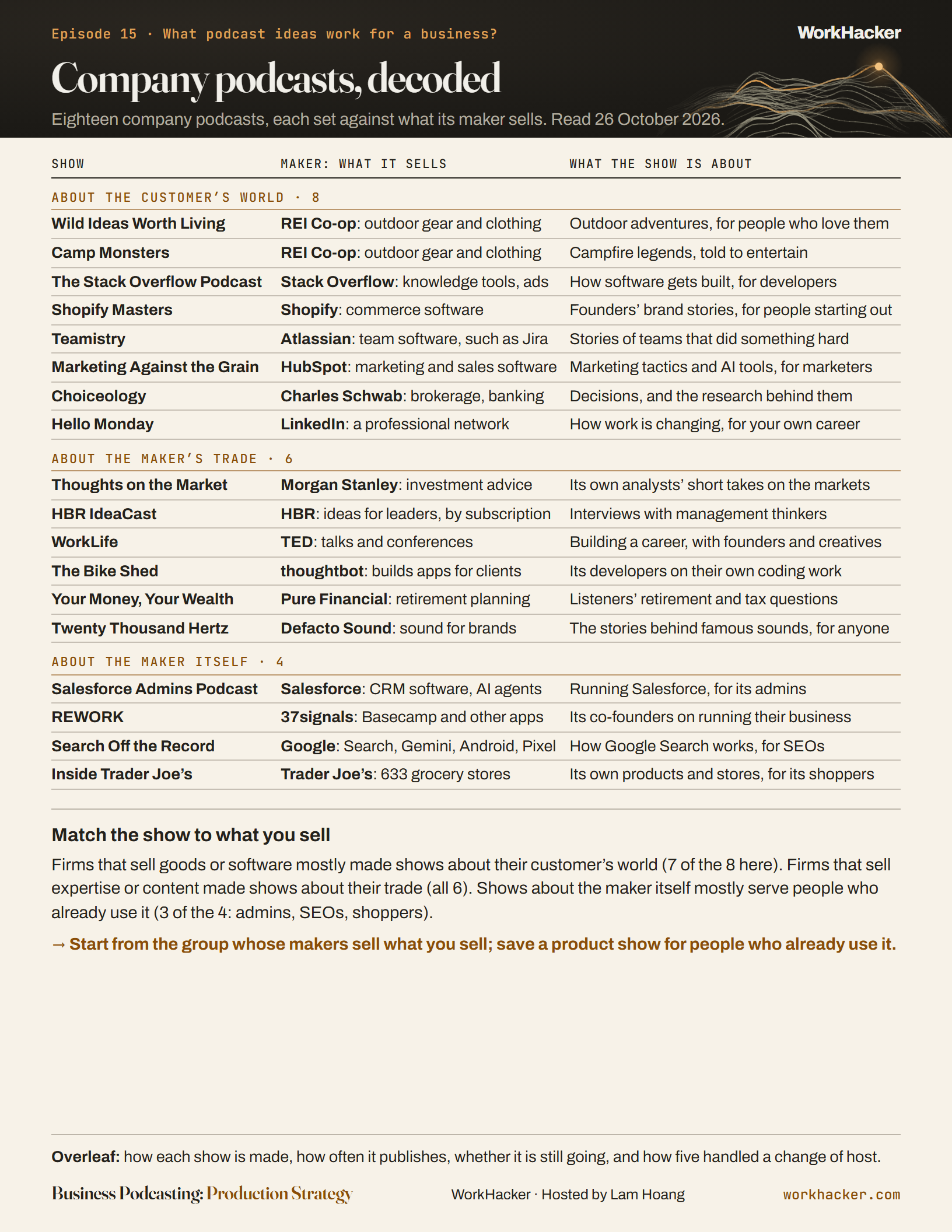
Company podcasts, decoded
Eighteen podcasts that companies make, each set against what the company sells, with who hosts, how often it publishes and whether it is still going, read on one date, plus a rule of thumb for picking the kind of show that matches your business.
Download PDFSources you can check.
Every reference, with the publication and checked dates we recorded.
- Wild Ideas Worth Living (show page)Apple Podcasts (description by REI Co-op)
Published: undatedChecked:
- The Stack Overflow PodcastStack Overflow (its blog)
Published: undated (latest post 2026-10-09)Checked:
- The Stack Overflow Podcast (show page)Apple Podcasts
Published: undatedChecked:
- Podcasts as a Source of News and InformationPew Research Center
Published: Checked:
- 1. How Americans use and engage with podcastsPew Research Center
Published: Checked:
- 2025 Benchmark Report: Branded PodcastsSignal Hill Insights
Published: Checked:
- Branded Podcast Made Them More Favorable Towards Brand Say 61% of ListenersSignal Hill Insights (press release via Podnews)
Published: Checked:
- Study: Branded Podcasts Aren't So Different And Need To Catch Listener AttentionInside Radio
Published: Checked:
- Golden Rules of Branded Podcasting: Signal Hill Insights releases 2025 Benchmark ReportRAIN News (Brad Hill)
Published: Checked:
- Camp Monsters (show page)Apple Podcasts (description by REI Co-op)
Published: undatedChecked:
- How to Start a Podcast STEP-BY-STEP: 2026 Complete Tutorial (UPDATED)Smart Passive Income (Pat Flynn)
Published: 2026 update (no day shown)Checked:
- How to Plan Your First Podcast 10 Episodes (The Framework We Use With Every Client)Smarter Podcasting (Niall Mackay)
Published: Checked:
- Acquired (show page)Apple Podcasts
Published: undatedChecked:
- PressAcquired
Published: undatedChecked:
- How to make a podcast people loveJay Acunzo
Published: Checked:
What did you think of this episode?
A question, a useful takeaway, or something we could do better. We'd like to hear it.
Your note goes to the WorkHacker team. It won't appear publicly.
What podcast ideas work for a business?
The week in search, ads and AI.
One email a week, on Fridays, with the week's changes in search, ads and AI and what to do about them.