How do you disclose AI in a podcast without losing trust?
Listen to the episodeTell listeners before they find out: one line as the episode opens, the detail in the notes, the line again on clips. Where you publish sets the floor.
Yours to useAI disclosure, platform by platform

Now listening
Use the progress bar to choose a moment.
Topics join your trail as you reach them.
Definitions appear here as you reach them.
Summary
- Telling costs some trust, and being found out costs more. In thirteen workplace experiments, people who said they had used AI were trusted less, and the steepest drop came when someone else uncovered it.
- The rules depend on where you publish, and they don't agree. Apple names synthetic voices with no exception. YouTube exempts a clone of your own voice for voice-overs. The strictest place you publish sets your floor.
- Keep the spoken line to one sentence as the episode opens. Put the detail in the notes: which parts AI made, how you used it, and your sources.
- Say it again wherever people miss the start. Clips and trailers come first: Instagram asks for realistic AI audio to be labeled, and TikTok for AI audio that copies a real person's voice.
- AI-made audio and AI-written words need a line. Clean-up that keeps the words usually doesn't, and a patched word is a grey zone. A label says how a show was made, not whether it's good.
My rule for AI disclosure: podcast listeners should hear it from you before they find out. In workplace experiments in 2025, saying you had used AI cost some trust, and being found out cost more. If listeners hear audio AI made, a voice or music, say so in one line as the episode opens. Put it in the notes, including when AI wrote the words you read. Say it again on clips and trailers, where people miss the start, and switch on the platform's AI setting where it has one. The rules where you publish set the minimum.
Narrated by a synthetic version of Lam Hoang's own voice.
Where do you have to say it?
As of October 2026, it depends on where you publish, and the rules don't agree. Take this show, voiced by a clone of its host. YouTube's page on disclosing AI content lists "Cloning one's own voice to create voice overs or dubs" among the uses that need no label. Apple's content guidelines , section 1.11, name synthetic voices with no exception and no threshold, as the episode on AI voices covered, and want the disclosure in the content and in the details of each episode and show. Section 1.12 bars using AI to mislead, and Apple may label or remove content that breaks its rules. So the strictest place you publish sets your floor.
YouTube's switch is a setting called AI use, in YouTube Studio, under the video's attributes. It's for realistic content, and it covers AI music when the music is "the main focus of the video". Select it and viewers see a label, which reads "Made with AI", per YouTube's page on how its disclosures appear . YouTube's own words: "Disclosing AI content alone won't limit a video's audience or impact its eligibility to earn money." So switching it on costs little, even where the list says you could skip it. The setting sits on each video. Check it on every episode, including ones pulled in from your feed. Leave it off, and YouTube may add a label itself, for content made with its own tools or detected as AI-generated, in some cases one the creator can't remove. Creators who consistently don't disclose may face penalties. Whether platforms flag AI-made podcasts on their own is for a later episode.
Your hosting company may have rules of its own. Acast's community guidelines , updated in November 2024, require disclosure for "using AI to replicate a host's voice or image" and for AI translation, and not for production help "such as reducing silence or enhancing audio quality". Podbean's acceptable use policy , updated in March 2026, requires it when Podbean's own AI features made your narration, descriptions, scripts or show notes, or altered your audio "beyond routine noise reduction or level adjustment". We didn't read other hosts' rules, so read yours.
Some hosts can also mark your feed. The open Podcasting 2.0 namespace has an "ai-content" value for its txt tag, a true or false flag for whether AI-generated content was used, at the show or episode level. RSS.com, a hosting company, began writing it into feeds in March 2026 , and Spreaker followed a few days later, by RSS.com's account. We found no major listening app that shows the flag to listeners, and the same guide still quotes Apple's older, narrower wording.
Spotify asks less. Its platform rules ban harmful synthetic media presented as real, and its impersonation policy removes podcasts that copy another creator's likeness without permission, "whether that's using AI cloning or any other method". Its Verified badge, extended to podcasts in May 2026 , marks a show's official presence, not human-made work. Its 2026 AI labels are for music: the badge is "about the artist's public identity, not about how the music was made", as NPR reported , and a trade newsletter's relay of Bloomberg points the same way. We found no AI label or setting for podcasts on Spotify's pages in October 2026.
Then there's the law. Article 50 of the EU's AI Act requires anyone deploying AI that generates or manipulates audio amounting to a deep fake to disclose it, "at the latest at the time of the first interaction or exposure". The duty applies from 2 August 2026, per the Commission's page on its code of practice . A deep fake is content that resembles real persons and "would falsely appear to a person to be authentic or truthful". The final guidelines, adopted in July 2026, count a person's voice, and Travers Smith's briefing lists voice cloning of a podcast's presenters among its examples. Whether content counts is assessed case by case, partly on what the audience expects, as Bird and Bird reads the guidelines . Fictional or artistic work gets a lighter duty, but informative or commercial content can't use it.
Does that reach a show made outside the EU? In the same firm's reading, content counts as used in the EU when it is posted "on the globally accessible internet", with no need to target the EU market. The Commission's code of practice is voluntary, while Article 50 is law. About 190 organisations had signed the code by the end of July 2026. For audio-only content, it asks for "a clear audible disclaimer at the start of the content", as Pearl Cohen summarises it . Wilson Sonsini's summary has a plain-language disclaimer at the beginning, and companies encouraged to add a second layer on "the type and extent of AI involvement". Fines for breaking the transparency duties reach EUR 15 million or 3 percent of global annual turnover, per Lewis Silkin . Except for one clean-up example below, we read the guidelines and the code's audio section through law firms' summaries, not in the original. This isn't legal advice.
What does telling cost?
Some trust, but hiding it can cost more.
The label alone moves ratings. In an online experiment in the Journal of Interdisciplinary Voice Studies , in its August 2026 issue, 200 people rated short novel excerpts read by humans or by one AI voice model, each with an accurate or a deliberately wrong label. Per the study's abstract , recordings labeled human were rated higher than those labeled AI, "regardless of the actual voice type". Real human voices labeled AI lost out too. Older participants showed smaller gaps. The limits: we read the abstract only, it doesn't say what the ratings measured, so I don't call them trust, and it gives no effect sizes. The excerpts weren't a show anyone knew. The authors name "the restricted voice set and non-interactive design".
So why tell? Because being found out costs more. Oliver Schilke and Martin Reimann ran thirteen experiments , published in 2025, with more than 5,000 people, among them students, legal analysts, hiring managers and investors. People who disclosed their AI use on work tasks were trusted less than people who didn't. The penalty held "regardless of whether disclosure is voluntary or mandatory", and it was "attenuated but not eliminated" among people who like technology. But it was weaker than when a third party exposed the AI use. In the authors' own summary , quietly using AI "can trigger the steepest decline in trust if others uncover it later". They say it's unclear whether the penalty will fade as AI spreads. The limit: work tasks, not podcasts or voices, so the size of either cost for a show is unknown. The work was university research funded by the US National Science Foundation.
Timing points the same way. In preliminary results presented at a US journalism conference in August 2025, Jacob A. Long and colleagues found that up-front AI bylines on news did not significantly change credibility, while "late disclosure of concealed AI use significantly reduced content and source credibility". That is news text, about a thousand people, and not yet a published paper.
Here's what being caught looks like in audio. In April 2025, Mediaweek reported that the host of a weekday music show on CADA, a Sydney digital station of the Australian Radio Network, was AI-generated. Global News , relaying the Australian Financial Review, said she had been on air "for approximately six months without any disclosure that she is artificial". It came out after a Sydney writer asked about the host in her newsletter. Part of the backlash was about who the AI host was modeled on, a network employee. But many listeners went online to say it should have been disclosed. It's one case, on music radio, and nobody counted how many listeners left.
What makes telling cost less? Showing what the work rests on. In a survey experiment with nearly 1,500 US adults in September 2023, Benjamin Toff and Felix M. Simon found that an AI label lowered trust in a news outlet, though readers didn't rate the articles as any less accurate or fair. Per their paper's record , that cost was "largely counteracted when articles disclose the list of sources used to generate the content". In Nieman Lab's account , 78 percent of respondents who wanted a disclosure wanted a note explaining how AI was used. Text news, a mock outlet, one country: whether sources in show notes do the same for audio is untested. I'd still list yours in the notes, beside the line.
Two podcasting teachers land on the same side. Daniel J. Lewis wrote in 2024 that disclosure "helps the potential audience know what kind of quality to expect". In 2025, Tom Webster of Sounds Profitable put the choice as whether creators "will get ahead of it or wait for the hammer to drop". Lewis sells courses, a membership and podcast tools; Sounds Profitable is funded by audio companies.
How short, and how often?
One sentence is enough, if the detail is easy to find. In a lab study of forty news readers , posted as a preprint in January 2026, trust declined "only for detailed AI disclosures", while readers checked sources more after both a one-line note and a detailed one. Yet about two in three preferred the detail, and most who preferred one line wanted detail on demand. The notes sat at the top of each article. Forty people, text news, a lab: a small study. So keep the spoken line short, and put the detail in the notes: which parts AI made, and how you used it.
This show's spoken line is one sentence, in the open: "You're hearing a synthetic version of my voice." This page and each episode's notes carry the written version. I worried a line at the start might stop people from even listening. We kept it there anyway.
How often? Where people may not hear the start, once isn't enough. Reed Smith's summary of the EU's final guidelines says that then "a single disclosure at the outset is not enough", and that this is "particularly relevant for audio consumption in background or 'eyes-free' contexts". The same summary says audio generated before 2 August 2026 needs no label. The code's first draft , in January 2026, went further and asked for repeats in audio longer than thirty seconds. So say it at the open, and again anywhere people join partway in.
Clips are the plainest case. A clip starts mid-episode, after your opening line. Meta announced in February 2024 that people must use its label tool when they post "realistic-sounding audio that was digitally created or altered" on Facebook, Instagram or Threads. The label has read "AI info" since July 2024 . TikTok has required labels since September 2023 on AI-generated content with realistic images, audio or video. Its current community guidelines , in force since 24 September 2026, list AI-generated audio that mimics a real person's voice among the cases that need a label, and accept your own clear caption, sticker or watermark as well as TikTok's AI label. Meta's rule is said here as announced, because its current help page couldn't be read, and it doesn't define "realistic". So give every clip and trailer its own line, on screen or in the caption. On Instagram, use the app's AI label as well.
What needs a label?
Anything listeners hear that AI made, and words AI wrote for you. Clean-up that keeps the words usually needs none. YouTube's list exempts "voice or audio repair", Acast's exempts enhancing audio quality, and Podbean's covers only changes beyond routine noise reduction. The EU's final guidelines agree: their examples of what isn't a deep fake, and so needs no EU label, include a radio broadcast where AI evens out volume and reduces noise "without altering the actual words spoken by speakers or their way of speaking". Apple lists no exemption at all.
Changing what someone says is different. YouTube wants a label when content makes "a real person appear to say or do something they didn't do". The US advertising trade body's 2026 framework draws a similar line: disclosure "only when AI materially affects authenticity, identity, or representation in ways that could mislead consumers". The IAB has an interest in workable rather than blanket labeling.
Patch one word with an AI copy of your voice, and you've put synthetic speech in a real recording. Editors can do it: Descript's help page for Regenerate says it can generate speech "to fix a flubbed delivery, a misspeak, or a wrong spoken word", from your custom AI speaker, in English, up to 250 characters at a time. YouTube's own-voice exception covers voice-overs and dubs, so it doesn't settle this, and Apple's rule names synthetic voices with no threshold. When in doubt, add a line to the notes.
When AI drafts your script, the notes should say so. YouTube asks nothing for script help. Podbean asks it only for scripts from its own generator. That's a minimum, not a reason to stay quiet: the workplace experiments were about using AI at all. This show is made with the help of AI, and How do you make a podcast with AI? says how it splits the work.
A label says how a show was made, not whether it's good. In May 2026, the podcast scholar Siobhan McHugh reviewed an AI-made series built from millions of released documents. Its notes were "upfront about the show being AI-generated", she wrote, and also boasted of "journalistic rigor". Yet "some highly problematic sources are cited as neutrally as if they were credible documents". One listener's review, from a critic who sells consultancy, courses and a book. So the label is a start, not a pass. The work behind it still has to hold up.
What does good disclosure look like, then? It meets the strictest rule where you publish. It's one short line as the episode opens, said again anywhere people could miss the start. And the detail sits in the notes, with your sources. It may cost a little trust, but being found out costs more.
What to do this week
- List every place people meet your show without hearing its start: clips and trailers first, then anything else. Check that each one carries the line.
- Write your spoken line: one sentence for the open that says what AI made.
- Write the notes' version: which parts AI made, how you used it, and the sources the episode rests on.
- On YouTube, set AI use on every episode, including ones pulled in from your feed. On Instagram, add the app's AI label to clips; on TikTok, a line on screen or in the caption.
- Read your host's AI rules and Apple's section 1.11. If people in the EU can hear the show, take the EU question to a lawyer.
- If you hire podcast production, agree who writes the line, the notes and the clip captions, and who switches the settings on.
FAQ
Do you have to disclose AI in a podcast?
It depends on where you publish. As of October 2026, Apple's content guidelines require creators using synthetic voices or other AI-made audio to disclose it in the content and in each episode's and show's details. YouTube has an AI use setting for realistic content. Since 2 August 2026, the EU requires a label on AI audio that could pass for a real person.
Does disclosing AI make listeners trust you less?
Some, but being found out costs more. In thirteen workplace experiments published in 2025, people who disclosed AI use were trusted less, and the steepest drop came when others uncovered it. Those were work tasks, not podcasts. In a 2026 online study of short voice clips, recordings labeled AI were rated lower, even real human voices.
Does AI audio clean-up need a label?
Usually not. YouTube's list exempts voice or audio repair, and Acast's rules exempt reducing silence or enhancing audio quality. Changing what someone says is different, and a word patched with an AI copy of your voice is a grey zone: when in doubt, note it in the show notes.
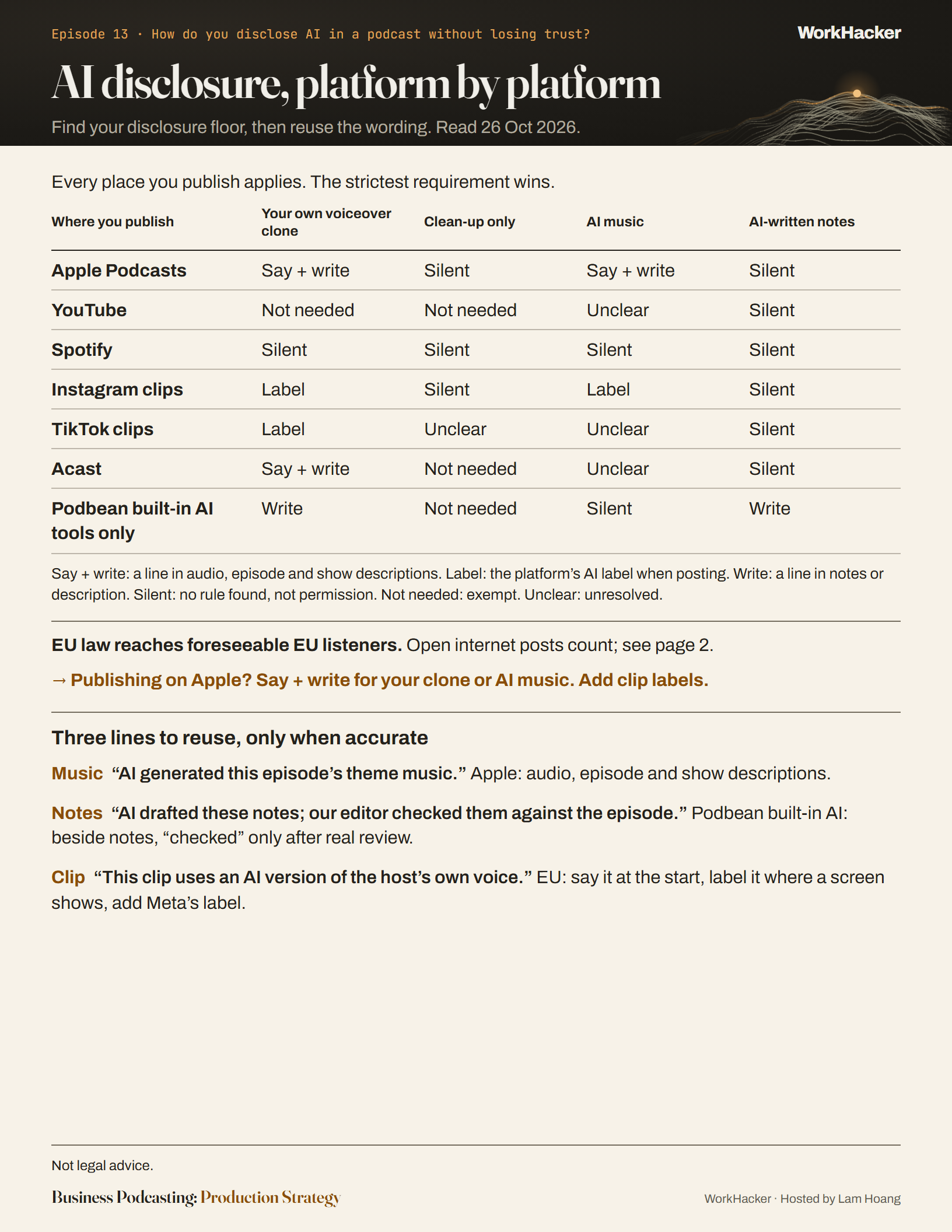 Open full-size preview
AI disclosure, platform by platform
Find the strictest disclosure across your destinations, with four common AI uses and three lines to reuse.
Download PDFSources you can check.
Every reference, with the publication and checked dates we recorded.
- The label effect in speech perception: Comparing AI-generated and human voices (abstract)Journal of Interdisciplinary Voice Studies 11.1 (Kipp and colleagues), abstract via CiteDrive
Published: Checked:
- Journal of Interdisciplinary Voice Studies 11.1 is out now!Intellect Books
Published: Checked:
- The transparency dilemma: How AI disclosure erodes trust (NSF Public Access Repository record)Organizational Behavior and Human Decision Processes (Schilke and Reimann), via the NSF Public Access Repository
Published: 2025-05Checked:
- Being honest about using AI at work makes people trust you less, research findsUniversity of Arizona News (Schilke and Reimann, from The Conversation)
Published: Checked:
- Content guidelinesApple Podcasts for Creators
Published: undatedChecked:
- Disclosing use of GenAI contentYouTube Help
Published: undatedChecked:
- Understanding "How this content was made" disclosures on YouTubeYouTube Help
Published: undatedChecked:
- Community Guidelines: use of AI in podcasts or podcast advertisingAcast
Published: Checked:
- Acceptable Use PolicyPodbean
Published: Checked:
- Txt (Podcast Namespace)Podcasting 2.0
Published: undatedChecked:
- AI Disclosure in Podcasting: What It Is, Why It Matters, and How to Do ItRSS.com blog (Alberto Betella)
Published: Checked:
- Spotify Platform RulesSpotify Safety and Privacy Center
Published: undatedChecked:
- Podcast content that impersonates another creator's likenessSpotify for Creators
Published: undatedChecked:
- Spotify extends 'Verified' badges to podcasts, further cracking down on AI impersonatorsMusic Business Worldwide (Mandy Dalugdug)
Published: Checked:
- Spotify will now label AI creators posing as human artistsNPR, republished by VPM
Published: Checked:
- Spotify's AI Disclosure, Acast Acquires Backyard Ventures, and MoreSounds Profitable, The Download (relaying Bloomberg)
Published: Checked:
- Article 50: Transparency obligations for providers and deployers of certain AI systemsEuropean Commission, AI Act Service Desk
Published: Checked:
- Code of Practice on Transparency of AI-generated ContentEuropean Commission, Shaping Europe's digital future
Published: undated (code published 2026-06-10)Checked:
- Is it a bot? EU AI Act transparency rules take effect 2 August 2026Travers Smith
Published: Checked:
- European Commission adopts final Guidelines on AI Act Article 50 transparency obligations: first impressionsBird and Bird
Published: Checked:
- The EU's new AI labelling rules: what every organisation needs to knowLewis Silkin
Published: Checked:
- EU Publishes Code of Practice on Transparency of AI-Generated ContentPearl Cohen
Published: Checked:
- EU Commission Publishes AI Transparency Code of PracticeWilson Sonsini, The Data Advisor
Published: Checked:
- Perceptions of AI-generated news: an experiment on disclosure type and timingJacob A. Long and colleagues, AEJMC conference talk abstract
Published: Checked:
- 'Tokenistic and backwards': Backlash over ARN's use of AI radio host modelled on Asian womanMediaweek (Natasha Lee)
Published: Checked:
- Australian radio station found to be using AI host but not telling listenersGlobal News
Published: Checked:
- 'Or they could just not use it?': the dilemma of AI disclosure for audience trust in news (Oxford Research Archive record)International Journal of Press/Politics (Toff and Simon), via the Oxford Research Archive
Published: 2024Checked:
- Most readers want publishers to label AI-generated articles, but trust outlets less when they doNieman Lab
Published: 2023-12Checked:
- 11 Warnings about Using AI in Content-Creation (including podcasting)The Audacity to Podcast (Daniel J. Lewis)
Published: Checked:
- The Robot In The Room, The Sleeping Giant, and MoreSounds Profitable, The Download (Tom Webster)
Published: Checked:
- Full Disclosure, Less Trust? How the Level of Detail about AI Use in News Writing Affects Readers' TrustarXiv (Prajod, Cools, Röggla and colleagues)
Published: Checked:
- Transparency obligations for AI-generated content: The Code of Practice adequacy decision and the final EU Commission Guidelines on Article 50 AI ActReed Smith
Published: Checked:
- AI Office Publishes Its First Code of Practice on AI-Generated Content Transparency (first draft)Bryan Cave Leighton Paisner
Published: Checked:
- Labeling AI-Generated Images on Facebook, Instagram and ThreadsMeta Newsroom (Nick Clegg)
Published: Checked:
- Our Approach to Labeling AI-Generated Content and Manipulated MediaMeta Newsroom (Monika Bickert)
Published: Checked:
- New labels for disclosing AI-generated contentTikTok Newsroom
Published: Checked:
- Use Regenerate to edit or change recorded audioDescript Help Center
Published: undatedChecked:
- AI Transparency and Disclosure FrameworkIAB (Interactive Advertising Bureau)
Published: Checked:
- AUDIO's BACK, BABY! And the fight against AI SLOPCASTSSiobhan McHugh (blog)
Published: Checked:
- Guidelines on the implementation of the transparency obligations for certain AI systems under Article 50 of Regulation (EU) 2024/1689 (the AI Act), C(2026) 5054 finalEuropean Commission
Published: Checked:
- Integrity and authenticity: Edited Media and AI-Generated Content (AIGC)TikTok Community Guidelines
Published: 2026-08-25 (effective 2026-09-24)Checked:
What did you think of this episode?
A question, a useful takeaway, or something we could do better. We'd like to hear it.
Your note goes to the WorkHacker team. It won't appear publicly.
How do you disclose AI in a podcast without losing trust?
The week in search, ads and AI.
One email a week, on Fridays, with the week's changes in search, ads and AI and what to do about them.