Which podcast production steps can AI do well?
Listen to the episodeAI now does transcripts, chapters, audio clean-up and first drafts well. Each step needs your check, and the show's point of view stays yours.
Yours to useWhere AI slips, step by step

Now listening
Use the progress bar to choose a moment.
Topics join your trail as you reach them.
Definitions appear here as you reach them.
Summary
- Some steps already happen for you. Apple makes transcripts and, for English shows, chapters; Spotify does both for shows it counts as eligible; YouTube dubs eligible videos. Your job there is checking theirs.
- Read every transcript as a first draft. The best system in a 2026 benchmark still got about one word in fourteen wrong on long recordings, and names are where to look hardest.
- AI clean-up and filler cuts help, but no independent test compares them with a person on podcast speech. Judge them by ear, at every cut.
- Research, show notes and scripts come back fluent. This year's tests found added claims and links that likely never existed, so check every draft against its source.
- Nobody has measured the time AI saves, step by step. Count what it lets you add, and keep the brief, the point of view and the final listen.
As of fall 2026, AI podcast tools do a lot of the production work well. They make transcripts and chapters, clean up the audio and cut the ums. They draft show notes and first scripts, find research leads and can even voice the show. Every step still needs your judgment. Two tests this year found AI adding claims no source made and citing links that likely never existed. So check its drafts against their sources, and judge the audio by ear. What the show is for, its point of view and the final listen stay yours.
Narrated by a synthetic version of Lam Hoang's own voice.
This page names steps, not products. Where a tool maker is named, it is because the page cited is the maker's own, and the claim is the maker's. Every platform and vendor page below was read on 10 October 2026. What AI can do keeps changing, so this map carries a date: fall 2026. The voice has its own episode, Should your podcast use an AI voice?, and its answer stands: if you have something to say and you're not making a podcast yet, a synthetic voice is a great option.
What do the platforms already do for you?
More than most checklists assume. Apple Podcasts generates a transcript after each new episode is published and labels it "Automatically generated", according to its creator page on transcripts . It covers shows in English and ten other languages, for listeners on iOS 17.4 or later. Transcripts that miss Apple's quality standards are not displayed. You can supply your own, or download Apple's, correct it and send it back through your RSS feed.
Chapters came next. For shows in English that don't provide their own, Apple generates chapters and labels them "Automatically created", per its page on chapters, links and more , which ties the newer features to iOS 26.2. You can switch them off in Apple Podcasts Connect, or supply your own.
Spotify generates transcripts, chapters, guests and topics automatically, but only for shows it counts as eligible, per its creator guide to automatic transcripts and chapters , published in September 2025. A show that doesn't see the features yet is told to keep building its audience. Spotify asks creators to edit its automatic chapter labels or timestamps for accuracy. Neither Apple nor Spotify publishes an accuracy figure.
So for these steps the work is checking theirs.
How good is automatic transcription?
Good, not finished. The Open ASR Leaderboard paper , in its version of March 2026, scores transcription systems on long English recordings: sociolinguistic interviews, company earnings calls and recorded talks. In its long-form table, the best average word error rate was 7.32, from a closed system: about one word in fourteen. A widely used open model scored 11.2, about one in nine. That arithmetic is ours.
Behind the numbers. These are not podcasts. The scoring drops punctuation, capitals and fillers such as "um", along with repetitions and repairs, so a word-for-word transcript would score worse. Every word counts the same, so the rate says nothing about names or numbers in particular. The counts are as of 27 March 2026, the live leaderboard keeps moving, and the co-authors include staff of companies that make speech models.
Names are where to look
Apple's same transcript page asks shows to put host and guest names in the show and episode descriptions "to ensure accurate spelling of these names in the transcript". It also warns that cross-talk and loud music make an episode harder to transcribe.
A 2026 preprint shows why names deserve the check. Zhou, Bartelds, Bianchi and Zou tested 15 speech recognition models on spoken street names : 15 models from four large providers, on recordings of US street names said by US participants from many language backgrounds. They found "an average transcription error rate of 44%". The mistakes caused routing errors for every group of speakers, but the routing distance errors were twice as large for speakers whose first language isn't English. Fine-tuning with fewer than 1,000 synthetic samples improved street-name accuracy for those speakers by nearly 60%, relative to the base models.
Behind the numbers. The abstract doesn't define that rate, so it is not the same as 44% of names wrong, and it is an average across fifteen systems, not the best one. These were single names said alone, not names inside a conversation, where context helps. It is a preprint, read from its abstract. Its measure and scope differ from the benchmark above, so the two figures can't be set side by side. What each says, separately, is that names are where to check.
Dubbing
YouTube dubs eligible creators' videos into other languages automatically, and the feature is on by default, per its help page on automatic dubbing . The page lists its own error types: mispronunciations, accents, dialects or background noise in the original, and trouble translating proper nouns, idioms and jargon. You can't edit a dub, but a manual review setting holds dubs back until you publish them. Quality may differ by language, and dubs may be regenerated over time. The page doesn't say whether podcast episodes delivered to YouTube by RSS are dubbed.
Can AI clean up your audio and cut the ums?
Yes, with your ears on it. The one documented case shows both sides. Lewis Tennant, a senior lecturer and podcaster at Auckland University of Technology, made a five-episode narrative documentary podcast with AI tools and evaluated them at every stage. His study, Augment, Not Replace , came out in the International Journal of Creative Media Research in March 2026.
The university's story on his study , published in May 2026 and read through an archived copy, reports the clean-up result. An AI speech enhancer improved three interviews that had background noise, but the processed audio "lacked the depth and richness typical of professional vocal recordings". His best results came from combining AI noise reduction with specialist engineering knowledge, and he did all the engineering himself.
Behind the numbers. One production, three interviews and the producer's own judgment, not a listening test. The comparison is with professional recordings, not with the noisy originals, so the story doesn't say the tool took depth away. The work dates from 2025 to early 2026.
His guidelines, in the same story, fit the whole map: treat AI output as a draft that needs checking, never as evidence; keep interpretive and ethical decisions human; and use AI for bounded tasks such as transcription, noise reduction, summarising and drafting, to free time for editorial craft.
Cutting the ums
Cutting fillers carries its own risk: clipping the words around them. Descript's help page on filler words describes a setting that skips any filler it can't remove without clipping into nearby words or leaving an awkward cut. It also lets you review, preview and decide on each cut. Detection works on English transcripts only. This is a tool maker describing its own feature, and the setting itself is the maker's acknowledgment that automatic cuts can clip words. There's no figure for how often.
What nobody has tested
The research for this episode found no independent, controlled test of AI clean-up or filler cuts against a human editor on podcast speech, and none of how well AI clip tools choose moments. There are only tool makers' own tests and claims. So listen to the cleaned audio before you publish, then listen again at every cut, and check what a clip picker chose. A missing test is a reason to check the tools, not to avoid them.
Can AI do the research, the show notes and the script?
It drafts them fluently, and that's the catch. In a 2026 study of podcasts made from documents , Dutta, Dhamecha and Shivaswamy had several large language models turn more than 1,500 documents in five domains into podcast scripts. They judged each turn of the conversation against its source, with an AI judge they validated through human studies. The systems "produce fluent and engaging narratives", they write, but "often introduce ungrounded information". A separate step that caught and rewrote the unfaithful turns made the scripts consistently more faithful.
Behind the numbers. A preprint, and its abstract gives no rates. The models tested include GPT-4o, a 2024 model, so the finding describes those models, not the best of 2026. Show notes drafted from your transcript are the same kind of task, a text made from a document. That is my reading: the study tested scripts.
Links that likely never existed
Research has the same weak spot. Rao, Wong and Callison-Burch checked the links that AI models and research agents cite in April 2026: 53,090 links from 10 models and research agents, and 168,021 from 3 models across 32 academic fields. Between 3% and 13% of cited links had no record in the Wayback Machine, so they likely never existed, and 5% to 18% didn't resolve at all. Deep-research agents cited more links and invented more of them than search-augmented models.
Given the authors' link checker, the models cut broken links by 6 to 79 times, to under 1%, though how well depended on the model's skill with tools. The checker and the data are public. And a working link only proves the page exists, not that it says what the AI claims it says.
How one producer used it
In Tennant's documentary, by his study's abstract , the chatbot helped with broad exploratory research and first leads in unfamiliar fields. It proved unreliable as a primary research tool, and he went back to conventional research. In scripting it did better in a back-and-forth, what he calls a mixed-initiative workflow, but the uneven quality kept the creative and editorial decisions with him. His university's account of the study adds that every factual claim needed independent checking. A documentary needs deeper research than most business shows, so his bar may sit higher than yours.
Listeners approve of AI research, as an idea
Edison Research's Podcast Consumer 2026 , released in June 2026 with SSRS, asked US weekly podcast consumers aged 13 and older about AI in early 2026. 69% approved of AI being used to conduct research, tied with brainstorming at the top. By Net Influencer's account of the report , approval fell to 48% for AI-generated scripts and 43% for AI-assisted audio editing. The same report found 62% consider AI a threat to the credibility of podcasts.
Behind the numbers. This is approval of an idea, not a test of the work, and not how people treat a show that discloses its AI. The base size and question wording are not on the pages read. Edison sells podcast ratings and research. It is a different dataset from the Edison question in the episode on AI voices, where two in three said they would react badly if a favorite host switched to an AI version of themselves.
Whatever listeners accept, check every draft against its source. Editing, transcripts and research each get their own episode later in the season.
Will AI save you time?
Maybe, but nobody has measured it step by step. The one survey that compared whole episodes is Alitu's Independent Podcaster Report 2025 , published in November 2025 by the podcast-software company behind The Podcast Host. Among its 558 respondents, podcasters who used AI assistants reported about the same average time per episode as those who didn't: "There was no clear difference." The company itself says there were too many variables to draw big conclusions. It adds that it would be misleading to say AI doesn't save time, only that it "won't necessarily" save you time.
Behind the numbers. These are self-reported hours from a self-selected sample: the company's own newsletter readers, blog and podcast audience and software users, plus partners' audiences, with a prize draw. Almost half were over 50. No table or test is shown. The report closes by advising a small toolkit and then offering its own product, so its reading fits its pitch and carries no extra weight either way.
The same survey shows what independent podcasters already hand to AI. These are shares of respondents past launch, with several answers allowed.
| What they use AI for | Share |
|---|---|
| Transcripts | 38% |
| Research, ideas and planning | 30% |
| Show notes and titles | 30% |
| Editing or sound enhancement | 27% |
| Marketing, including clips | 21% |
| Voice cloning or synthetic hosts | 3% |
Source: Alitu's Independent Podcaster Report 2025 , read on 10 October 2026. 17% said they don't use AI and don't plan to, and 16% said they aren't using it yet but would like to.
The episode on AI voices said a synthetic voice cuts the time a show takes by a lot. This survey can't test that: only three in a hundred of its podcasters used one. Both points stand. No study has counted the hours any single step saves.
Count what AI lets you add
So what's the case for handing steps over? Paul Colligan, president of the consultancy Podcast Partnership and a 2026 Podcast Hall of Fame inductee, made it in the notes to a February 2025 episode of The Podcast Report : the point isn't to automate your show, it's to do what used to cost too much time or money. Those are show notes, not his spoken words, and he sells consulting and coaching, including on AI workflows.
A transcript of every episode is that kind of step. So is a dub in another language. Count what AI lets you add, not just the hours.
What should stay yours?
A show you want to stand out still takes a great deal of judgment. Without your shaping, AI falls back on a default. That's where the episode on AI voices left off.
Jill Walker Rettberg of the University of Bergen uploaded different kinds of text to one AI podcast tool, NotebookLM's Audio Overviews, and analysed what it made. Her 2026 study of AI-generated podcasts , in Media, Culture and Society, found that "the podcasts' structure is built around a fixed template". The tool also turned other languages into a standard Mid-Western American accent, and other cultural contexts into a white, educated, middle-class American default.
Behind the numbers. One tool as it worked in 2025 and 2026, analysed qualitatively and read here from the abstract. It is not a claim about every tool, or about a show you direct. And because the tool built different documents into one template, handing it your own material alone doesn't escape the default.
So be explicit before AI starts. Give it the show's structure, your sources and your point of view.
The facts held; the style didn't
In September 2026, the business podcaster Noah Kagan, who runs AppSumo, wrote about cloning his podcast voice . He had an AI assistant turn one of his articles into a script, added a story of his own, cloned his voice from about two hours of old episodes and sent the result to his editor. The editor asked if he was sick, called the intonation and spacing weird, and said "it's not your usual style". Everything in it was true, Kagan writes, because it came from a colleague's document. His verdict: "The personality wasn't." That is one case, in his own account, in a post that promotes his newsletter.
Someone who can hold it back
The Washington Post tested AI-generated personal podcasts before launching them in December 2025. Semafor reported on the testing : three rounds of internal tests failed between 68% and 84% of the scripts, with testers told to fail a script "as a precaution" when in doubt. The Post launched anyway, and its spokesperson called the product a beta. Within 48 hours of launch, people inside the Post had flagged errors and fictional quotes : four sources described mistakes from pronunciation gaffes to misattributed or invented quotes and inserted commentary. One product, reported from internal documents and staff sources.
So a person has to listen to every episode, and they need the power to hold it back. This show is made with the help of AI, and I listen to every episode before it goes out. How it splits the work is in How do you make a podcast with AI?
Where do you begin?
AI can already help you do a lot of the work of making a show. I'd start it on the steps where a mistake is easy to catch and cheap to fix: transcripts and chapters, then clean-up and cuts. Then let it draft what you'll check against a source: show notes, research leads and a first script. Keep the brief, the point of view and the final listen.
That order is my judgment. No study tests an order of handover. Listeners in Edison's report approved of AI-assisted audio editing less readily than of AI research, 43% against 69%. That is approval of an idea and says nothing about what a mistake costs, so the order stands.
All of this is as of fall 2026. Claims about what AI can't do wear out fast, so date any you rely on, and test again when the tools change.
Hiring a producer instead? CoHost's report on the state of podcast agencies , announced in January 2026, found that 92% of the 51 agencies it surveyed use AI "in some part of their workflow", particularly for transcription, show notes and audio editing. Any use counts, so it says nothing about how much of the work. CoHost sells podcast analytics, its chief executive also runs a branded-podcast agency among the participants, and we read the press release, not the full report. So if you hire podcast production, ask which steps a tool does, and what a person checks them against.
What to do this week
- Open the automatic transcript of your last episode. In Apple Podcasts, touch and hold the episode, then tap View Transcript.
- Check every name and number against what was said. Put host and guest names in the episode description, so the next transcript spells them right.
- Decide whether to keep Apple's automatic chapters or supply your own. If YouTube dubs your videos, turn on review before the dubs go out.
- Run AI clean-up or filler cuts on one episode, then listen to the whole result and again at every cut.
- For any AI draft, open every cited link and check that the page says what the draft claims.
- Write down the show's brief and point of view, and name the person who listens to every episode and can hold it back.
FAQ
Can AI transcribe a podcast accurately?
Mostly, not perfectly. In a 2026 benchmark of long English recordings, the best system still got about one word in fourteen wrong, before counting fillers, and those recordings were interviews, earnings calls and talks, not podcasts. Read every automatic transcript as a first draft, and check names hardest.
Does AI save time making a podcast?
Nobody has measured it step by step. In Alitu's 2025 survey of 558 independent podcasters, those using AI reported about the same time per episode as those who weren't, and the company says AI won't necessarily save time. The clearer case is what AI lets you add, such as a transcript of every episode.
Should you let AI write your podcast script?
As a first draft you check, yes. A 2026 study found that AI models often added information their source documents didn't contain, and a separate check-and-repair step made the scripts more faithful. Keep the brief, the point of view and the final listen with a person.
 Open full-size preview
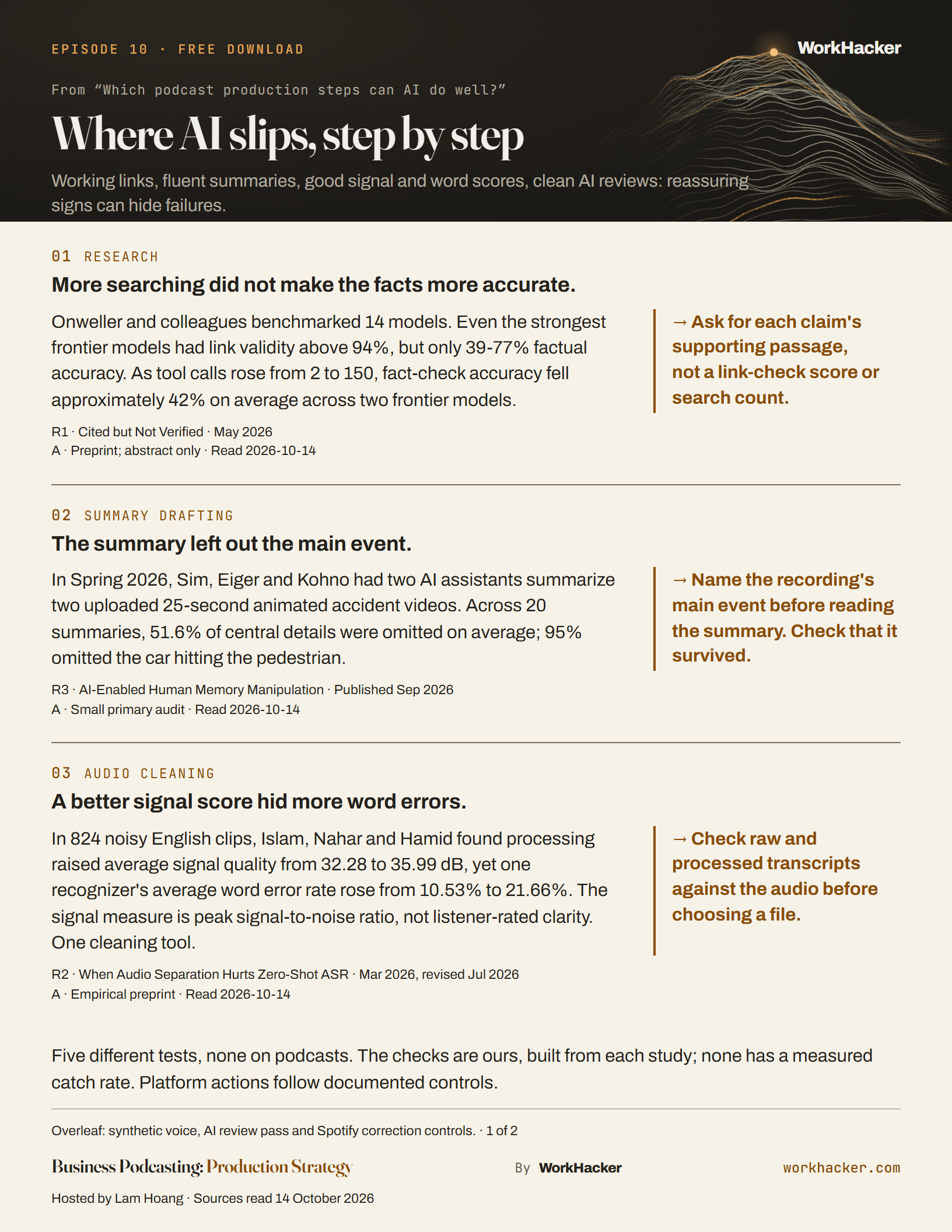
Where AI slips, step by step
Five research findings relevant to podcast production checks: which reassuring scores hid failures, and what to ask a producer to show.
Download PDFSources you can check.
Every reference, with the publication and checked dates we recorded.
- Transcripts on Apple PodcastsApple Podcasts for Creators
Published: undatedChecked:
- Enhance your episodes with chapters, links, and moreApple Podcasts for Creators
Published: undated (refers to iOS 26.2)Checked:
- Amplifying your show on Spotify with automatic transcripts, chapters, and moreSpotify for Creators
Published: Checked:
- Open ASR Leaderboard: Towards Reproducible and Transparent Multilingual and Long-Form Speech Recognition Evaluation (version 4)arXiv (Srivastav and colleagues)
Published: Checked:
- "Sorry, I Didn't Catch That": How Speech Models Miss What Matters MostarXiv (Zhou, Bartelds, Bianchi and Zou)
Published: Checked:
- Use automatic dubbingYouTube Help
Published: undatedChecked:
- Augment, Not Replace: Utilising AI Tools for Documentary Podcast ProductionLewis Tennant, International Journal of Creative Media Research 13 (Auckland University of Technology repository)
Published: Checked:
- AI can be helpful in podcast production (archived 17 May 2026)Auckland University of Technology, via the Internet Archive
Published: Checked:
- Filler wordsDescript Help Center
Published: undatedChecked:
- On Improving Faithfulness of Podcasts from DocumentsarXiv (Dutta, Dhamecha and Shivaswamy)
Published: Checked:
- Detecting and Correcting Reference Hallucinations in Commercial LLMs and Deep Research AgentsarXiv (Rao, Wong and Callison-Burch)
Published: Checked:
- The Podcast Consumer 2026Edison Research at SSRS
Published: Checked:
- Podcast Audiences Are Buying Into The Host ... Brands May Need To Do The SameNet Influencer
Published: Checked:
- The Independent Podcaster Report 2025: Inside the Minds of 558 CreatorsAlitu (the company behind The Podcast Host)
Published: Checked:
- The Podcast Report (RSS feed): Use AI to Elevate, Not Replace, Your PodcastPaul Colligan, The Podcast Report (his own feed)
Published: Checked:
- AI-generated podcasts: Synthetic Intimacy and Cultural Mistranslation in NotebookLM's Audio OverviewsarXiv (Jill Walker Rettberg); Media, Culture and Society
Published: Checked:
- Is This AI Slop? I Cloned My Podcast VoiceNoah Kagan (his own post)
Published: Checked:
- 'Iterate through': Why The Washington Post launched an error-ridden AI productSemafor
Published: Checked:
- Washington Post's AI-generated podcasts rife with errors, fictional quotesSemafor
Published: Checked:
- CoHost Releases Annual Report on the State of Podcast Agencies in 2026CoHost (press release via Podnews)
Published: Checked:
What did you think of this episode?
A question, a useful takeaway, or something we could do better. We'd like to hear it.
Your note goes to the WorkHacker team. It won't appear publicly.
Which podcast production steps can AI do well?
Notes on search, AI and automation.
Practical notes from WorkHacker, delivered by email when we have something useful to share.