Podcast names: how do you choose one people can find?
Listen to the episodeName your podcast for the words people search and credit your company as the producer. If most listeners hear of it first, a distinctive name can work.
Yours to usePodcast names: what search reads, and what it skips

Chapter 1 of 3Who Must Find It
Topics join your trail as you reach them.
Definitions appear here as you reach them.
In October 2026, Apple's public search tool listed at least 32 shows named exactly Let's Talk About It. In my opinion, podcast names people can find carry the words a stranger would search, and the company goes in the producer credit, not the title. That fits a show strangers will mostly find by searching a topic. If most listeners will hear about yours from someone, a distinctive name can work. Either way, the name has to say what the show covers, be findable after one hearing, and belong to no other show.
Narrated by a synthetic version of Lam Hoang's own voice.
Summary
- If strangers have to find the show, name it for the term they search. If most listeners will hear about it from someone first, a distinctive name can work.
- Put the company in the producer credit and the author field, not at the front of the title.
- On Apple, the name and the episode titles carry the search words. In two tests the description did little there. On Spotify it counts.
- Leave keyword lists out of the title and the author field. Apple's rules require metadata that describes the show accurately.
- Before committing, check that no other show has the name, that it can be spelled and found after one hearing, and that it tells a stranger what the show is about.
Who has to find your podcast?
Start with who has to find the show. If strangers will find it by searching a topic, the name needs the words they would type. James Cridland, editor of the trade newsletter Podnews, gave the example in a written Q and A for Podcast Bestie . A show about great fish and chips should be called that, not The Codfather. Otherwise, people searching for a fish and chips podcast won't find it.
His reason, in the same answers: Apple Podcasts did not search show descriptions. That reason comes from a 2021 test he ran with a colleague (covered in the next section), so it is the same evidence again, not a second confirmation. Cridland sells Podnews sponsorship, events and workshops, and consults.
Word of mouth gives a name more room. Spotify's naming guide says a name can be concrete and direct, or abstract and mysterious. Either way, it should hint at the show's topic, tone, theme or format. The same guide warns that a title too narrow might box the show in. Spotify first published it under another title in September 2020 and rewrote it in August 2026. So decide who the show is for before brainstorming names.
Generic names get lost. Spotify's guide to podcast search , rewritten the same month, says a title that is too generic gets buried. Its example of a colliding name is The Business Podcast, which it says competes with hundreds of shows using the same words. When we searched Apple's index for that name , one show carried it exactly. So Spotify's figure counts shared words, not shared names. An earlier version of the same guide advised names of three to four words. Spotify runs a hosting service, and neither guide gives data for its claims about what a name does.
The 32 is our own count. On 10 October 2026 we ran the phrase through Apple's free iTunes Search API and compared names without case or punctuation. Of the 98 shows returned, 32 are named exactly Let's Talk About It: 32 feeds from 31 publishers, 15 of them with an episode dated 2026. The API returns about 100 results at most, so 32 is a floor, and its order is not the app's ranking. It counts shared names. It does not measure what a shared name costs a show.
A hosting company had made the same estimate a year earlier. On its own show in October 2025, Buzzsprout put the number at about 35 , and made the point that a show sharing its name with dozens of others can't be recommended to a friend. In the same episode it launched an AI name generator that checks for existing titles.
The episode on starting a podcast for your business had a test: describe the show in ten words or fewer, in a way that describes nothing else. A name is the shortest version of that.
Which words does podcast search read?
On Apple, the evidence points to the show name and the episode titles. The description counts for little there.
Apple's own page, How Search works on Apple Podcasts , lists the show name, the channel name and the episode title as the metadata its search uses. It also weighs popularity (follows and plays) and what people play or follow from search results. Ratings, reviews and shares are not factored in. It publishes no weights. The page carries no date. Podnews reported it as new in June 2022, and it had not changed when we read it in October 2026.
The independent evidence is older. In July 2021, Mark Steadman and James Cridland of Podnews planted nonsense words in each field of two of their own feeds, then searched for them in 14 apps. Apple found the words in the show name, the episode titles and the author field. Apple, Amazon Music and Pocket Casts missed the one in the description. Spotify found it. The authors concluded that search in apps such as Overcast, Pocket Casts and Spotify seemed built mainly to find a show by name, not by topic. Their advice: make the show easy to find by name.
That test is five years old, and two of its apps have since closed: Stitcher in 2023 and Google Podcasts in the US in 2024 . We found no independent re-test of Apple since. One vendor has run its own. In October 2025 the hosting company Ausha published a test of near-identical podcasts, each with one invented keyword in one field. On Apple, a keyword in the show title or an episode title lifted the show in results. The author field and the transcript appeared to count. Descriptions had little to no impact. On Spotify, both titles and both descriptions all mattered. The page shows no counts and no results table. Ausha sells hosting and search tools, and elsewhere on the same page it lists descriptions among what Apple ranks on.
Some guides put search words in the description. Pat Flynn's 2026 guide to starting a podcast says to use the keyword phrases your audience uses there, written for people, because people read descriptions. Spotify's search guide says the topic and the host's name belong in the description, since new listeners most often find shows by searching one or the other. On Spotify, both tests back that. On Apple, it may do little. Flynn sells courses and a community, and earns from tools his guide recommends.
The web is a separate case, and here the evidence is only ours. A show's name works as a search term on the web too. Hosting and directory sites already carry weight with search engines like Google, so a name built on the term lets their pages rank for you. In a way, you borrow their authority. A show we produced was named for its search term. Within days of publishing it was on Google's first page for that term, through its host's page and the Apple, Spotify and aggregator pages.
That is one show, in my own account. Its feed now returns a "gone" error, no copy of that results page was saved, and it does not show that the name caused the result. No source we found tests the reasoning.
So put the words a stranger would type in the name, and let the episode titles carry the rest. The description still helps on Spotify and on the web. Choosing topics and episode titles people search for gets its own episode.
Where does your company's name go?
If the company isn't at the front of the name, it goes in two places: the producer credit and the show's author field. This show does it in its open. The name comes first, then "produced by WorkHacker", the company that makes podcasts for businesses. Leading with the brand, as in The Acme Podcast followed by a colon and a description, spends words a searcher won't type.
Apple's guide for podcasters on RSS says the author field most often holds the parent company or network behind a show, and the host when there is none. It says author information is especially useful when a company publishes several podcasts. It also says to pay close attention to the title, because Apple uses it for search. The same wording is in an archived copy of the guide from February 2023.
Apple's search page does not list the author field. The 2021 test found Apple searched it anyway, the 2025 vendor test found it appeared to count, and the podcasting teacher Daniel J. Lewis says every app he tested searches it .
Make two or more shows and Apple lets you group them in a channel , set up in Apple Podcasts Connect under a name of up to 25 characters. Apple suggests a single channel to highlight a brand. Since iOS 16.4 in 2023, people who follow one show in a channel see the channel. Apple's search page lists the channel name among what its search reads. That a channel is a brand field Apple's search reads is our reading of the two pages, not Apple's statement.
A made-up case shows the pattern. A roofing company makes a show for people fixing up old houses. The name might be Old House Repair. The company's name goes in the author field, and the open says the show is produced by the company.
Should you add keywords after the podcast name?
Daniel J. Lewis says in an episode on words to avoid in a title that the title field holds only the title. Not a tagline, and not a list of keywords. He once recommended taglines himself, a practice he says was popular before 2018. He allows one exception: a short line expanding the title. If a title has to be explained, he adds, it might not be a good title. He calls his points guidelines, not laws.
In November 2018 he wrote that Apple had removed his own show , and that Apple's support team pointed especially to his author tag, as well as extra words in the title. He had built a course on podcast search by then. Lewis sells courses, consulting, a membership and tools.
The case for taglines comes from companies that sell rank tracking. Each study below counted rankings on one day or in one pass. None changed a title and watched what followed.
| Study | Sample | What it counted |
|---|---|---|
| PodSEO taglines analysis, March 2026 | 332,528 active English podcasts, data from 24 February 2026 | Shows with a tagline in both title and author field ranked for nearly 7 times more Apple keywords; 0.58% use both |
| PodSEO search analysis, May 2026 | About 11 million keyword pairs on one day, 4 May 2026 | 12.0% of Apple rank-1 shows carry the searched keyword in name and author; 8.3% on Spotify |
| Ausha study of Apple search, March 2024 | About 1,000 keywords and 7 million search results | 65% of top-10 shows had the keyword in the show title; Ausha puts the gain at about five places |
Source: PodSEO's taglines analysis , PodSEO's search analysis and Ausha's study, as Podnews published it .
PodSEO's taglines analysis says so itself: "Our analysis shows correlation, not causation." The rates also disagree, 65% of top-10 shows against 12.0% of rank-1 shows. PodSEO's second analysis suggests experimenting with a short tagline in both fields. It also warns that Apple and Spotify have de-ranked or truncated metadata that is too obviously gamed. Ausha's figure comes with no comparison group. Each firm sells rank tracking or search tools.
Apple's rules point the other way. Its content guidelines say a show's metadata must accurately represent its content, and that creators must not try to influence search with inaccurate or inappropriate terms. Apple may label or remove the content, or suspend the account. Its RSS guide warns that a long list of keywords meant to game search may get a show removed from the directory. Apple publishes no count of removals, and neither page says anything about a short, accurate line after a name.
The 2021 test's authors made the listener's point. A keyword-stuffed name can win a new listener for one episode, they wrote, but it is not how you keep them or earn their trust. The show still has to be valuable, accurate and true to the business. So no keyword lists, in the title or the author field.
How do you know the podcast name is yours?
Start with three free checks.
- Taken or free. Search the name in the podcast apps, then as a web address and a social handle, as Spotify's naming guide advises. Everyday phrases are crowded. On the same day as the Let's Talk About It count, Apple's index held nine shows named exactly Real Talk , and 49 whose names start with it. Real Talk was Cridland's own example of a crowded name in 2022.
- Heard once, found. Say the name to someone once, and see whether they can spell it and find it. Buzzsprout calls this its say-spell-search test . Spotify's guide adds that a show should generally be spelled as it sounds, and suggests trying a shortlist on people you trust with a mock cover.
- Clear to a stranger. Ask someone who doesn't know the show what it is about, from the name alone. If they are still confused, Lewis suggests a different title .
Then one more question, if owning the name matters. Cridland registered his own show's name as a trademark. The US Patent and Trademark Office's page on strong trademarks calls descriptive names weak: hard to protect against competitors, and often not federally registrable. Strong marks are suggestive, invented or arbitrary. A descriptive mark registers only in certain cases, such as gaining distinctiveness through extensive use over many years. A name made only of the search phrase is likely descriptive. That is our reading of general guidance, not legal advice.
So if owning it matters, add something distinctive. A made-up word is easier to protect. Your own name won't fix a plain title. Lewis, relaying his podcast lawyer, says adding it doesn't make a non-distinctive title more trademarkable, while made-up words and mashups are much easier. He gives the name one use: when many shows share a generic title, yours in it can help listeners pick the right one.
What to do this week
- Decide who has to find the show first: strangers searching a topic, or people who will hear about it. That decides whether the name carries a search term.
- List the words a stranger would type for the show's topic. Draft three names that use them, or that hint at the topic if the show will spread by word of mouth.
- Search each name in Apple Podcasts and Spotify, then as a web address and a social handle. Drop any name another show already uses.
- Say the best candidate once to someone who doesn't know the show. Ask what they think it's about, then watch them search for it.
- Put the company's plain name in the author field, and write the producer credit into the open.
- If owning the name matters, add something distinctive, and take the trademark question to a lawyer.
FAQ
Should a business podcast put the company name in the title?
Not at the front, in my view. A title like The Acme Podcast followed by a description spends words a searcher won't type. Put the company in the show's author field and in the producer credit instead. Apple's guide for podcasters says the author field most often holds the company or network behind a show.
Does the podcast description help people find the show?
On Spotify, yes: Podnews's 2021 test and Ausha's 2025 test both found Spotify's search reads it. On Apple, the same tests found the description did little, and Apple's own search page lists the show name, the channel name and the episode title instead. A description written for people still helps on the web.
How do you check if a podcast name is taken?
Search the exact name in Apple Podcasts, Spotify and other podcast apps, then as a web address and a social handle, as Spotify's naming guide advises. Expect crowding on everyday phrases: in October 2026, Apple's search tool listed at least 32 shows named exactly Let's Talk About It. A name other shows already use is hard for a friend to find.
 Open full-size preview
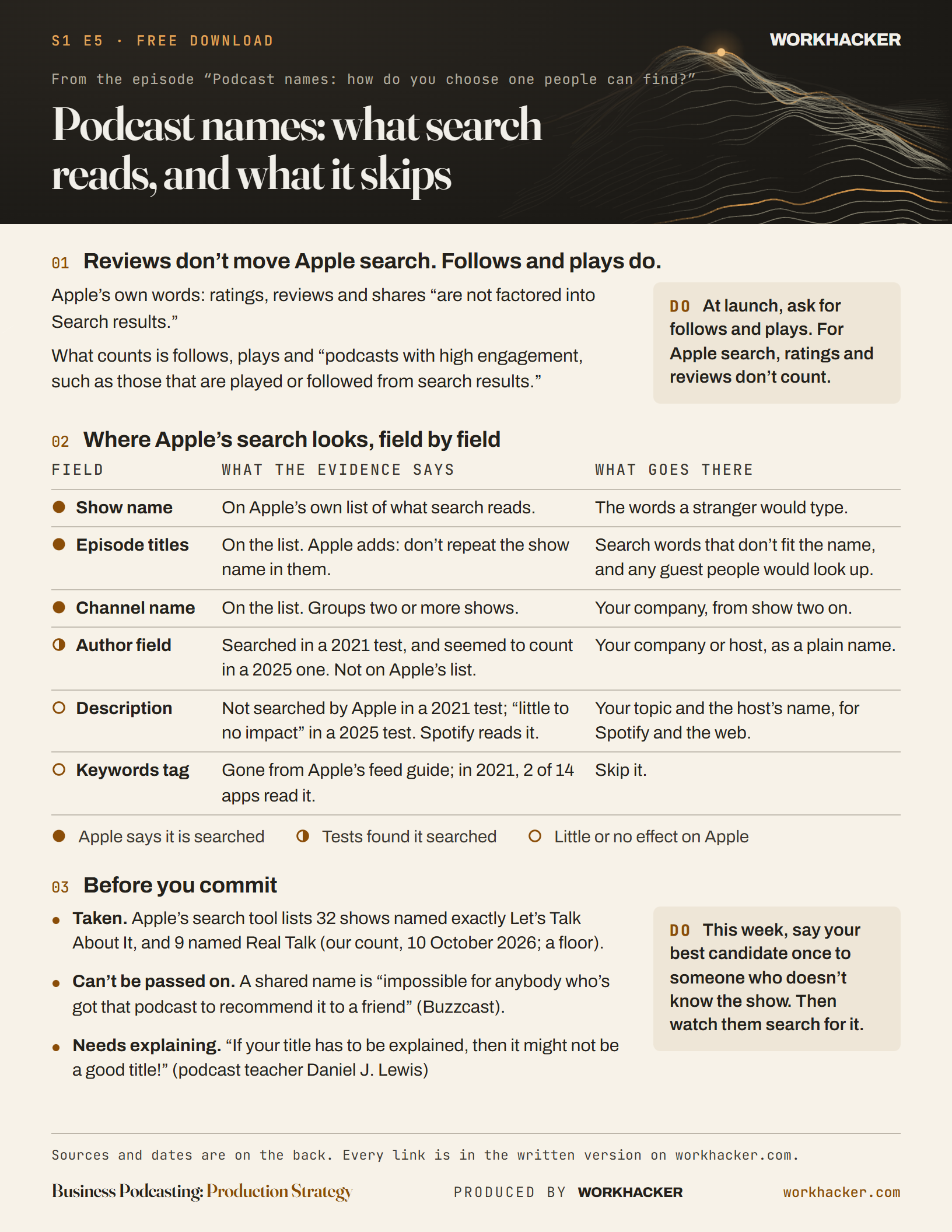
Podcast names: what search reads, and what it skips
Which fields Apple's search reads, why reviews don't move it, and how to tell a name you can find from one you can own. Free, front and back, every fact dated.
Download PDFRead along with the episode
Who Must Find It
This is Business Podcasting: Production Strategy, produced by WorkHacker. I'm your host, Lam Hoang, co-founder of WorkHacker. You're hearing a synthetic version of my voice. Each episode I take one question about making a podcast for your business, tell you what I would do and how solid the evidence is. Today's question: how do you choose a podcast name people can find?
This October, Apple's public search tool listed at least thirty-two shows named exactly Let's Talk About It. Tell a friend about one of them. Which one do they find? So what should yours be called? In my opinion, name it for the words people search. Then credit your company as the producer. It fits a show that strangers will mostly find by searching a topic.
What if most people will hear about yours from someone, or already come for you? Then a distinctive name can work. Either way, the name has to say what the show covers. Someone who hears it once should be able to find it. And no other show should have it already. Here's what you'll leave with. Who your name is for, and which words search can see. Then where your company goes, whether to add keywords and how to check it's yours.
First: who has to find your show? Strangers searching a topic? Then it needs the words they'd type. Take a show about great fish and chips. James Cridland edits the trade newsletter Podnews, and he'd probably call it just that. Call it The Codfather instead? Then people searching for fish and chips won't find it. And if listeners come by word of mouth?
That gives you more room. Spotify's naming guide says a name can be abstract and mysterious, not only direct. Even then, it should hint at the show's topic or tone. So decide who it's for before you brainstorm names. Either way, don't go generic. Spotify's guide warned in August 2026 that a title that's too generic gets buried.
Remember those thirty-two shows? That's too generic. Too narrow might box you in, though. The episode on starting a podcast had a test. Describe your show in ten words or fewer, in a way that describes nothing else. A name is the shortest version of that.
Search and Your Brand
Second: which words does search actually read? On Apple, the evidence points to the name and your episode titles. The description? Not so much. As of October 2026, Apple's help page lists the show name and episode titles among what its search reads. Then there's a 2021 test by the trade site Podnews.
It planted nonsense words in real feeds, then searched for them app by app. Apple found the words in the name, the episode titles and the author field. It missed the one in the description. Spotify found that one. Its authors said search in several other apps seemed built mainly to find a show by name. So make yours easy to find by name, they advised.
That test is five years old. But a hosting company's own test last year found descriptions made little difference on Apple too. Apple doesn't publish how much each part counts. Some guides tell you to put your search words in the description. That works on Spotify. On Apple, it may do little. What about the web? Here's our reasoning. A show's name works as a search term there too.
Hosting and directory sites already carry a lot of weight with search engines like Google. So a name built on the term lets their pages rank for you. In a way, you borrow their authority. A show we produced was named for its search term. Within days it was on Google's first page for that term, through its host's page and the big directories.
That's one show. And it doesn't prove the name did it. So put the words a stranger would type in the name, and let your episode titles carry the rest. The description still helps on Spotify and the web. Choosing topics and episode titles people search for gets its own episode. Third: if your company isn't at the front of the name, where does it go?
Two places: your producer credit and your show's author field. You heard that credit at the top of this episode. The name first, then who produces it. Why not lead with the brand? Picture The Acme Podcast, then a colon and a description. That spends words a searcher won't type. Apple's guide for podcasters says the author field most often holds the company or network behind a show.
If there isn't one, it holds the host. Make two or more shows? Apple lets you group them in a channel, which can carry your brand. Apple's search reads a channel's name too. Here's a made-up case. Say you run a dental practice. Your show is for people weighing dental implants. The name might be Dental Implant Answers. Your company's name goes in the author field, and the open says the show is produced by you.
Before You Commit
Fourth: what about a few keywords after the name? Podcasting teacher Daniel J. Lewis says a title should be only the title. Not a tagline, and not a list of keywords. And he's taught a whole course on podcast search. He makes an exception for a short line expanding the title. He says Apple kicked out his own show in 2018, mostly over extra words in its author field.
So who says taglines help? A rank-tracking company. It studied more than three hundred thousand English shows on a single day earlier this year. Shows with a tagline in both their name and author fields ranked for far more keywords. Its own write-up calls that correlation, not causation. Apple's rules also say a show's details must describe it accurately, not sway search with inaccurate terms.
Its guide for podcasters warns that a long keyword list may get a show removed. And a keyword-stuffed name might win a listener for one episode, one of the 2021 test's authors wrote. But that's not how you keep them. The show still has to be valuable and accurate. It also has to be true to your business. So no keyword lists, in the title or the author field.
Last, how do you know the name is really yours? Start with three free checks. One: is it taken? Search the name in the podcast apps. Then as a web address and a social handle. Everyday phrases are crowded. Apple's search tool also listed nine shows named exactly Real Talk. Two: say it to someone once.
Can they spell it and find it? That's one hosting company's say-spell-search test. Spotify adds that a show should generally be spelled as it sounds. Three: ask a stranger what the show is about, from the name alone. If they're confused, consider a different name. Then one more question, if you want to own the name. The Podnews editor from earlier registered his own show's name as a trademark.
The US trademark office calls descriptive names weak trademarks, hard to protect against competitors. A name made only of the search phrase is likely one of those. That's a reading of general guidance, not legal advice. The office registers such names only in certain cases, such as after many years of use. So if owning it matters, add something distinctive.
A made-up word is easier to protect. And your own name? It won't make a plain title easier to protect. Here's how it fits together. If strangers have to find it, name it for the term they search. And put your company in the credit, not the title. Episode titles take the search words that don't fit. If they'll mostly hear about it from someone first, something distinctive is fine.
Either way, skip the keyword lists. And check that no other show has it. Here's one thing to try this week. Say your best candidate to someone who doesn't know the show. Ask what they think it's about. Then watch them search for it. What Apple's search reads in a podcast name, and what it skips, is free to download with the written version.
And that's it for today's question. Thanks for listening. The written version is on workhacker.com, with every source. And if you want a podcast like this for your business, WorkHacker makes them. See you next time.
Sources you can check.
Every reference, with the publication and checked dates we recorded.
- iTunes Search API: podcasts matching "let's talk about it" (our count of exact names)Apple (iTunes Search API); count by WorkHacker
Published: Checked:
- Business and Tech 101 for Indie Podcasters (a written Q and A with James Cridland of Podnews)Podcast Bestie (Courtney Kocak)
Published: Checked:
- From podcast idea to first episode: A creator's guideSpotify for Creators
Published: Checked:
- How to choose a great show or podcast name (the 2020 version, archived 2026-04-10)Spotify for Creators, via the Internet Archive
Published: Checked:
- Words matter: How to get your podcast SEO rightSpotify for Creators
Published: Checked:
- Words matter: How to get your podcast SEO right (the 2022 version, archived 2026-01-23)Spotify for Creators, via the Internet Archive
Published: Checked:
- iTunes Search API: podcasts matching "the business podcast" (our count of exact names)Apple (iTunes Search API); count by WorkHacker
Published: Checked:
- Creating Original Podcast Names For Discovery (Buzzcast episode 196, transcript)Buzzcast (Buzzsprout)
Published: Checked:
- How Search works on Apple PodcastsApple Podcasts for Creators
Published: undated (first archived 2022-06-15)Checked:
- How Apple Podcasts search worksPodnews (James Cridland)
Published: Checked:
- How people find your podcast in apps: who indexes what?Podnews (Mark Steadman, with James Cridland)
Published: Checked:
- The Stitcher podcast app is to closePodnews (James Cridland)
Published: Checked:
- Google Podcasts shuts down in the US9to5Google (Abner Li)
Published: Checked:
- Mastering the Apple Podcasts and Spotify Algorithms to Maximize Your VisibilityAusha Academy
Published: Checked:
- How to Start a Podcast STEP-BY-STEP: 2026 Complete Tutorial (UPDATED)Smart Passive Income (Pat Flynn)
Published: 2026 update (no day shown)Checked:
- A Podcaster's Guide to RSSApple Podcasts Connect help
Published: undated (current wording first archived 2023-02-10)Checked:
- A Podcaster's Guide to RSS (archived 2023-02-10)Apple Podcasts Connect help, via the Internet Archive
Published: Checked:
- Avoid These Words in Your Podcast TitleThe Audacity to Podcast (Daniel J. Lewis)
Published: Checked:
- Create a channelApple Podcasts for Creators
Published: undated (names iOS 16.4, 2023)Checked:
- Kicked from Apple Podcasts? What Happens When You Keyword-Stuff Podcast TagsThe Audacity to Podcast (Daniel J. Lewis)
Published: Checked:
- The Hidden SEO Power of Podcast Taglines: 6.7x Better RankingsPodSEO Blog
Published: Checked:
- The Music DNA of Podcast Search: Why Apple and Spotify Still Rank Like Record StoresPodSEO Blog
Published: Checked:
- Ausha unveils Exclusive Study about Apple Podcasts AlgorithmAusha, via Podnews press releases
Published: Checked:
- Apple Podcasts content guidelinesApple Podcasts for Creators
Published: undatedChecked:
- iTunes Search API: podcasts matching "real talk" (our count of exact names)Apple (iTunes Search API); count by WorkHacker
Published: Checked:
- Strong trademarksUnited States Patent and Trademark Office
Published: Checked:
What did you think of this episode?
A question, a useful takeaway, or something we could do better. We'd like to hear it.
Your note goes to the WorkHacker team. It won't appear publicly.
Podcast names: how do you choose one people can find?
Notes on search, AI and automation.
Practical notes from WorkHacker, delivered by email when we have something useful to share.